所屬科目:研究所、轉學考(插大)◆普通物理學
1. A ball of mass m, at one end of a string of length L, rotates in a vertical circle just fast enough to prevent the string from going slack at the top of the circle. Assuming mechanical energy is conserved, the speed of the ball at the bottom of the circle is: (A) (B)(C)(D)(E)
2. The coefficient of static friction between a certain cylinder and a horizontal floor is 0.40. If the rotational inertia of the cylinder about its symmetry axis is given by I = (1/2)MR², then the maximum acceleration the cylinder can have without sliding is: (A) 0.1g (B) 0.2g (C) 0.4g (D) 0.8g (E) 1.0g
3. A large water tank, open at the top, has a small hole in the bottom. When the water level is 30 m above the bottom of the tank, the speed of the water leaking from the hole: (A) is 2.5 m/s (B) is 24 m/s (C) is 44 m/s (D) cannot be calculated unless the area of the hole is given (E) cannot be calculated unless the areas of the hole and tank are given
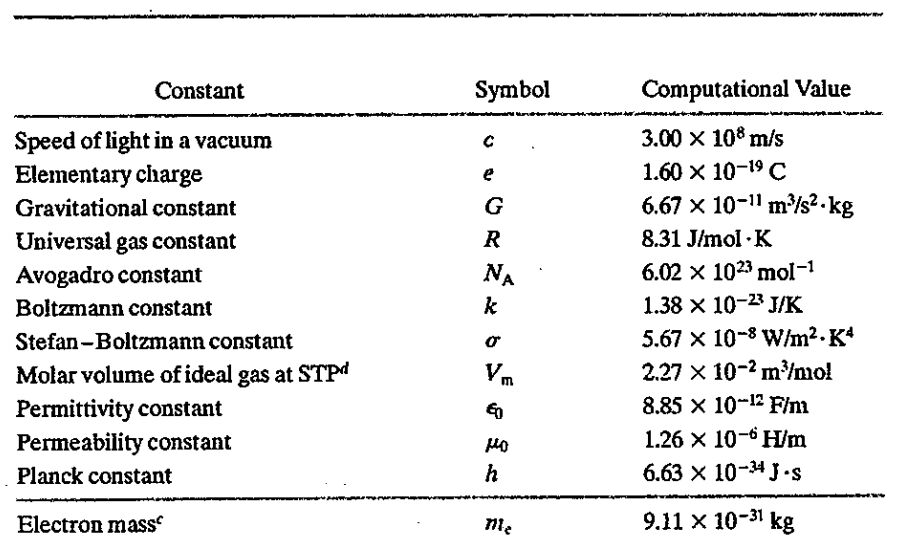
4. Use R = 8.2 × 10⁻⁵ m³·atm·mol⁻¹·K⁻¹ and Nₐ = 6.02 × 10²³ mol⁻¹. The approximate number of air molecules in a 1 m³ volume at room temperature (300 K) and atmospheric pressure is: (A) 2.2 × 10²⁰ (B) 2.4 × 10²⁵ (C) 2.7 × 10²⁶ (D) 5.4 × 10²⁸ (E) 2.2 × 10³⁰
5. One mole of an ideal gas expands reversibly and isothermally at temperature T until its volume is doubled. The change of entropy of this gas for this process is: (A) R·ln 2 (B) (ln 2)/T (C) 0 (D) RT·ln 2 (E) 2R
6. Positive charge Q is distributed uniformly throughout an insulating sphere (not a shell) of radius R, centered at the origin. A particle with a positive charge Q is placed at x = 2R on the x axis. The magnitude of the electric field at x = R/2 on the x axis is: (A) Q/72πε0R² (B) Q/8πε0R² (C) 7Q/18πε0R² (D) 11Q/18πε₀R² (E) none of these
7. The Earth's electric field creates a potential that increases 100 V for every meter of altitude. If an object of charge +4.5 mC and mass 68 g falls a distance of 1.0 m from rest under the influence of the Earth's electric and gravitational fields, what is its final kinetic energy? (A) 0.22 J (B) 0.45 J (C) 0.67 J (D) 1.1 J (E) 7.2 J
8. Take the potential energy of a hydrogen atom to be zero for infinite separation of the electron and proton. Then the ground state energy of a hydrogen atom is −13.6 eV. The energy of the first excited state is: (A) 0 eV (B) −3.4 eV (C) −6.8 eV (D) −27.2 eV (E) −54.4 eV
9. π⁺ represents a pion (a meson), μ represents a muon (a lepton), νₑ represents an electron neutrino (a lepton), and ν_μ represents a muon neutrino (a lepton). Which of the following decays might occur? (A) π⁺ → μ⁻ + ν̄_μ (B) π⁺ → μ⁺ + νₑ (C) π⁺ → μ⁺ + ν̄ₑ (D) π⁺ → μ⁺ + ν̄_μ (E) π⁺ → μ⁺ + ν_μ
10. An LC circuit has a capacitance of 30 μF and an inductance of 15 mH. At time t = 0 the charge on the capacitor is 10 μC and the current is 20 mA. The maximum current is: (A) 15 mA (B) 20 mA (C) 25 mA (D) 35 mA (E) 42 mA
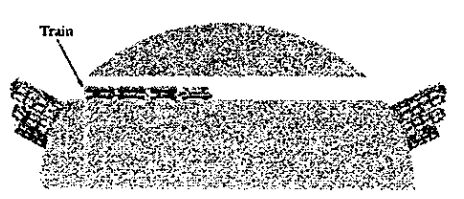
11. To alleviate the traffic congestion between two cities such as Paris and Seattle, engineers have proposed building a rail tunnel along a chord line connecting the cities. A train, unpropelled by any engine and starting from rest, would fall through the first half of the tunnel and then move up the second half. Assuming Earth is a uniform sphere and ignoring air drag and friction, find the city-to-city travel time. (Use 6.37 ×10⁶ m for earth radius and 5.98 × 10²⁴ kg for earth mass) (10分)
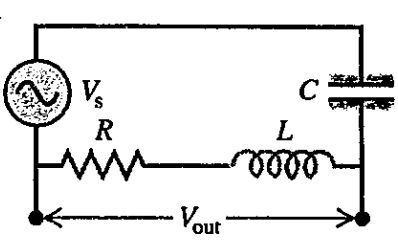
12. A High-Pass Filter. One application of L-R-C series circuits is to high-pass or lowpass filters, which filter out either the low- or high-frequency components of a signal. A highness filter is shown in Figure, where the output voltage is taken across the L-R combination. (a) Derive an expression for (Vout / Vs), the ratio of the output and source voltage amplitudes, as a function of the angular frequency ω of the source and R, L, and C parameters. (b) Show that when ω is small, this ratio is proportional to ω and thus is small, and (c) show that the ratio approaches unity in the limit of large frequency. [15分, find the reactance of L and C to construct the voltage and current]
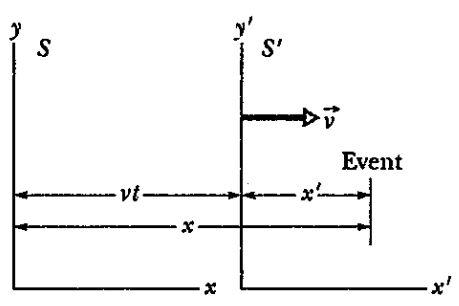
13. In Figure, observer S detects two flashes of light. A big flash occurs at x₁ = 1200 m and, 5.00 μs later, a small flash occurs at x₂ = 480 m. As detected by observer S', the two flashes occur at a single coordinate x'. (a) What is the speed parameter of S', and (b) is S' moving in the positive or negative direction of the x axis? To S', (c) which flash occurs first and (d) what is the time interval between the flashes? (15分)
 阿摩線上測驗
登入
 (B)
 (C)
 (D)
 (E)