所屬科目:Exam P:Probability機率
13. In modeling the number of claims filed by an individual under an automobile policy during a three-year period, an actuary makes the simplifying assumption that for all integers n ≥ 0 , p ( n+1)=0.2p(n) where p(n) represents the probability that the policyholder files n claims during the period. Under this assumption, calculate the probability that a policyholder files more than one claim during the period. (A) 0.04 (B) 0.16 (C) 0.20 (D) 0.80 (E) 0.96
15. An insurance company determines that N, the number of claims received in a week, is a random variable with P[N=n]= where n ≥ 0 . The company also determines that the number of claims received in a given week is independent of the number of claims received in any other week. Calculate the probability that exactly seven claims will be received during a given two-week period. (A) 1/256 (B) 1/128 (C) 7/512 (D) 1/64 (E) 1/32
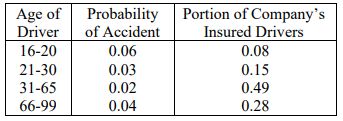
18. An auto insurance company insures drivers of all ages. An actuary compiled the following statistics on the company’s insured drivers: A randomly selected driver that the company insures has an accident. Calculate the probability that the driver was age 16-20. (A) 0.13 (B) 0.16 (C) 0.19 (D) 0.23 (E) 0.40
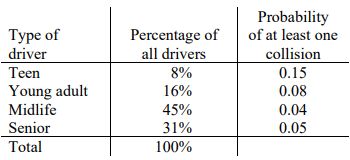
22. An actuary studied the likelihood that different types of drivers would be involved in at least one collision during any one-year period. The results of the study are: Given that a driver has been involved in at least one collision in the past year, calculate the probability that the driver is a young adult driver. (A) 0.06 (B) 0.16 (C) 0.19 (D) 0.22 (E) 0.25
23. The number of injury claims per month is modeled by a random variable N with P[N=n]=, for nonnegative integers, n. Calculate the probability of at least one claim during a particular month, given that there have been at most four claims during that month. (A) 1/3 (B) 2/5 (C) 1/2 (D) 3/5 (E) 5/6
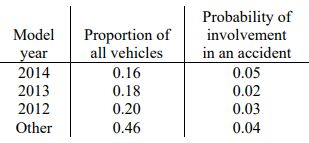
26. A study of automobile accidents produced the following data: An automobile from one of the model years 2014, 2013, and 2012 was involved in an accident. Calculate the probability that the model year of this automobile is 2014. (A) 0.22 (B) 0.30 (C) 0.33 (D) 0.45 (E) 0.50
29. An actuary has discovered that policyholders are three times as likely to file two claims as to file four claims. The number of claims filed has a Poisson distribution. Calculate the variance of the number of claims filed. (A)(B) 1 (C)(D) 2 (E) 4
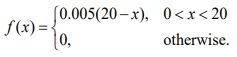
32. The loss due to a fire in a commercial building is modeled by a random variable X with density function Given that a fire loss exceeds 8, calculate the probability that it exceeds 16. (A) 1/25 (B) 1/9 (C) 1/8 (D) 1/3 (E) 3/7
33. The lifetime of a machine part has a continuous distribution on the interval (0, 40) with probability density function f(x), where f(x) is proportional to on the interval. Calculate the probability that the lifetime of the machine part is less than 6. (A) 0.04 (B) 0.15 (C) 0.47 (D) 0.53 (E) 0.94
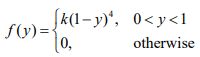
34. A group insurance policy covers the medical claims of the employees of a small company. The value, V, of the claims made in one year is described by V = 100,000Y where Y is a random variable with density function where k is a constant.Calculate the conditional probability that V exceeds 40,000, given that V exceeds 10,000. (A) 0.08 (B) 0.13 (C) 0.17 (D) 0.20 (E) 0.51
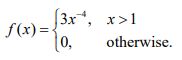
36. An insurance company insures a large number of homes. The insured value, X, of a randomly selected home is assumed to follow a distribution with density function Given that a randomly selected home is insured for at least 1.5, calculate the probability that it is insured for less than 2. (A) 0.578 (B) 0.684 (C) 0.704 (D) 0.829 (E) 0.875
38. An insurance policy pays for a random loss X subject to a deductible of C, where 0< C< 1 . The loss amount is modeled as a continuous random variable with density functionGiven a random loss X, the probability that the insurance payment is less than 0.5 is equal to 0.64. Calculate C. (A) 0.1 (B) 0.3 (C) 0.4 (D) 0.6 (E) 0.8
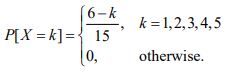
42. An insurance policy pays 100 per day for up to three days of hospitalization and 50 per day for each day of hospitalization thereafter. The number of days of hospitalization, X, is a discrete random variable with probability function Determine the expected payment for hospitalization under this policy. (A) 123 (B) 210 (C) 220 (D) 270 (E) 367
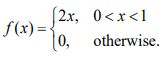
43. Let X be a continuous random variable with density function Calculate the expected value of X. (A) 1/5 (B) 3/5 (C) 1 (D) 28/15 (E) 12/5
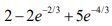
44. A device that continuously measures and records seismic activity is placed in a remote region. The time, T, to failure of this device is exponentially distributed with mean 3 years. Since the device will not be monitored during its first two years of service, the time to discovery of its failure is X = max(T, 2). Calculate E(X). (A)(B)(C) 3 (D) (E) 5
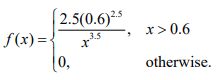
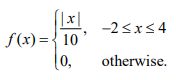
48. A manufacturer’s annual losses follow a distribution with density function To cover its losses, the manufacturer purchases an insurance policy with an annual deductible of 2. Calculate the mean of the manufacturer’s annual losses not paid by the insurance policy. (A) 0.84 (B) 0.88 (C) 0.93 (D) 0.95 (E) 1.00
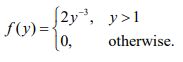
50. An insurance policy reimburses a loss up to a benefit limit of 10. The policyholder’s loss, Y, follows a distribution with density function: Calculate the expected value of the benefit paid under the insurance policy. (A) 1.0 (B) 1.3 (C) 1.8 (D) 1.9 (E) 2.0
 阿摩線上測驗
登入
 where n ≥ 0 . The company also determines that the number of claims received in a given week is independent of the number of claims received in any other week.
 , for nonnegative integers, n.
 (B) 1 (C)
 (D) 2 (E) 4
 on the interval.
 (B)
 (C) 3 (D)
 (E) 5