所屬科目:Exam P:Probability機率
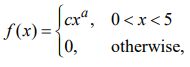
161. The distribution of the size of claims paid under an insurance policy has probability density function Where a >0 and c > 0. For a randomly selected claim, the probability that the size of the claim is less than 3.75 is 0.4871. Calculate the probability that the size of a randomly selected claim is greater than 4. (A) 0.404 (B) 0.428 (C) 0.500 (D) 0.572 (E) 0.596
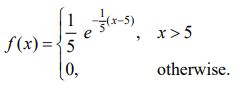
166. The distribution of values of the retirement package offered by a company to new employees is modeled by the probability density function Calculate the variance of the retirement package value for a new employee, given that the value is at least 10. (A) 15 (B) 20 (C) 25 (D) 30 (E) 35
169. An insurance company will cover losses incurred from tornadoes in a single calendar year. However, the insurer will only cover losses for a maximum of three separate tornadoes during this timeframe. Let X be the number of tornadoes that result in at least 50 million in losses, and let Y be the total number of tornadoes. The joint probability function for X and Y is where c is a constant. Calculate the expected number of tornadoes that result in fewer than 50 million in losses. (A) 0.19 (B) 0.28 (C) 0.76 (D) 1.00 (E) 1.10
173. Let N denote the number of accidents occurring during one month on the northbound side of a highway and let S denote the number occurring on the southbound side. Suppose that N and S are jointly distributed as indicated in the table. Calculate Var (N | N + S = 2). (A) 0.48 (B) 0.55 (C) 0.67 (D) 0.91 (E) 1.25
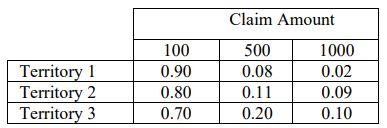
174. An insurance company has an equal number of claims in each of three territories. In each territory, only three claim amounts are possible: 100, 500, and 1000. Based on the company’s data, the probabilities of each claim amount are: Calculate the standard deviation of a randomly selected claim amount. (A) 254 (B) 291 (C) 332 (D) 368 (E) 396
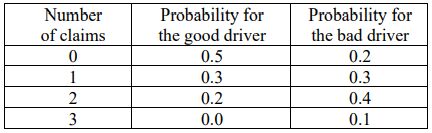
176. An insurance company insures a good driver and a bad driver on the same policy. The table below gives the probability of a given number of claims occurring for each of these drivers in the next ten years. The number of claims occurring for the two drivers are independent. Calculate the mode of the distribution of the total number of claims occurring on this policy in the next ten years. (A) 0 (B) 1 (C) 2 (D) 3 (E) 4
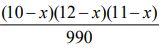
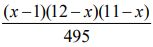
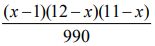
179. Four distinct integers are chosen randomly and without replacement from the first twelve positive integers. Let X be the random variable representing the second largest of the four selected integers, and let p be the probability function for X. Determine p(x), for integer values of x, where p(x) > 0. (A)(B)(C)(D)(E)
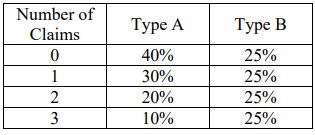
187. An actuary has done an analysis of all policies that cover two cars. 70% of the policies are of type A for both cars, and 30% of the policies are of type B for both cars. The number of claims on different cars across all policies are mutually independent. The distributions of the number of claims on a car are given in the following table. Four policies are selected at random. Calculate the probability that exactly one of the four policies has the same number of claims on both covered cars. (A) 0.104 (B) 0.250 (C) 0.285 (D) 0.417 (E) 0.739
194. A health insurance policy covers visits to a doctor’s office. Each visit costs 100. The annual deductible on the policy is 350. For a policy, the number of visits per year has the following probability distribution: A policy is selected at random from those where costs exceed the deductible. Calculate the probability that this policyholder had exactly five office visits. (A) 0.050 (B) 0.133 (C) 0.286 (D) 0.333 (E) 0.429
 阿摩線上測驗
登入


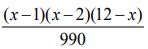 (B)
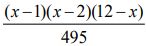 (C)
 (D)
 (E)