所屬科目:Exam P:Probability機率
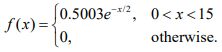
51. An auto insurance company insures an automobile worth 15,000 for one year under a policy with a 1,000 deductible. During the policy year there is a 0.04 chance of partial damage to the car and a 0.02 chance of a total loss of the car. If there is partial damage to the car, the amount X of damage (in thousands) follows a distribution with density function Calculate the expected claim payment. (A) 320 (B) 328 (C) 352 (D) 380 (E) 540
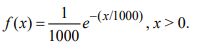
52. An insurance company’s monthly claims are modeled by a continuous, positive random variable X, whose probability density function is proportional to for 0 < x<∞ . Calculate the company’s expected monthly claims. (A) 1/6 (B) 1/3 (C) 1/2 (D) 1 (E) 3
54. An insurer's annual weather-related loss, X, is a random variable with density functionCalculate the difference between the 30th and 70th percentiles of X. (A) 35 (B) 93 (C) 124 (D) 231 (E) 298
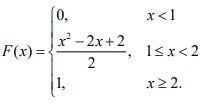
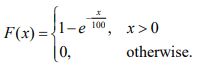
56. A random variable X has the cumulative distribution function Calculate the variance of X. (A) 7/72 (B) 1/8 (C) 5/36 (D) 4/3 (E) 23/12
57. The warranty on a machine specifies that it will be replaced at failure or age 4, whichever occurs first. The machine’s age at failure, X, has density function Let Y be the age of the machine at the time of replacement. Calculate the variance of Y. (A) 1.3 (B) 1.4 (C) 1.7 (D) 2.1 (E) 7.5
58. A probability distribution of the claim sizes for an auto insurance policy is given in the table below: Calculate the percentage of claims that are within one standard deviation of the mean claim size. (A) 45% (B) 55% (C) 68% (D) 85% (E) 100%
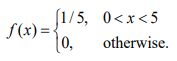
61. An insurance policy reimburses dental expense, X, up to a maximum benefit of 250. The probability density function for X is:where c is a constant. Calculate the median benefit for this policy. (A) 161 (B) 165 (C) 173 (D) 182 (E) 250
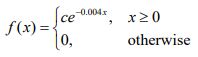
63. An insurance company sells an auto insurance policy that covers losses incurred by a policyholder, subject to a deductible of 100. Losses incurred follow an exponential distribution with mean 300. Calculate the percentile of losses that exceed the deductible. (A) 600 (B) 700 (C) 800 (D) 900 (E) 1000
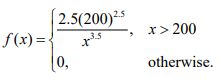
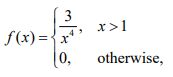
64. Claim amounts for wind damage to insured homes are mutually independent random variables with common density function where x is the amount of a claim in thousands. Suppose 3 such claims will be made. Calculate the expected value of the largest of the three claims. (A) 2025 (B) 2700 (C) 3232 (D) 3375 (E) 4500
70. The total claim amount for a health insurance policy follows a distribution with density function The premium for the policy is set at the expected total claim amount plus 100. If 100 policies are sold, calculate the approximate probability that the insurance company will have claims exceeding the premiums collected. (A) 0.001 (B) 0.159 (C) 0.333 (D) 0.407 (E) 0.460
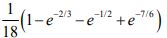
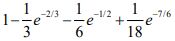
73. The waiting time for the first claim from a good driver and the waiting time for the first claim from a bad driver are independent and follow exponential distributions with means 6 years and 3 years, respectively. Calculate the probability that the first claim from a good driver will be filed within 3 years and the first claim from a bad driver will be filed within 2 years. (A)(B)(C)(D)(E)
82. A diagnostic test for the presence of a disease has two possible outcomes: 1 for disease present and 0 for disease not present. Let X denote the disease state (0 or 1) of a patient, and let Y denote the outcome of the diagnostic test. The joint probability function of X and Y is given by: P[X = 0, Y = 0] = 0.800 P[X = 1, Y = 0] = 0.050 P[X = 0, Y = 1] = 0.025 P[X = 1, Y = 1] = 0.125 Calculate Var(Y|X =1) (A) 0.13 (B) 0.15 (C) 0.20 (D) 0.51 (E) 0.71
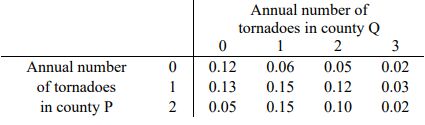
83. An actuary determines that the annual number of tornadoes in counties P and Q are jointly distributed as follows: Calculate the conditional variance of the annual number of tornadoes in county Q, given that there are no tornadoes in county P. (A) 0.51 (B) 0.84 (C) 0.88 (D) 0.99 (E) 1.76
84. You are given the following information about N, the annual number of claims for a randomly selected insured: Let S denote the total annual claim amount for an insured. When N = 1, S is exponentially distributed with mean 5. When N > 1, S is exponentially distributed with mean 8. Calculate P(4 < S < 8). (A) 0.04 (B) 0.08 (C) 0.12 (D) 0.24 (E) 0.25
85. Under an insurance policy, a maximum of five claims may be filed per year by a policyholder. Let p n( ) be the probability that a policyholder files n claims during a given year, where n = 0,1,2,3,4,5. An actuary makes the following observations: i) p(n)≥p(n+1) for n=0, 1, 2, 3, 4 .ii) The difference between p (n) and p (n+1) is the same for n = 0,1,2,3,4.iii) Exactly 40% of policyholders file fewer than two claims during a given year.Calculate the probability that a random policyholder will file more than three claims during a given year.(A) 0.14(B) 0.16(C) 0.27(D) 0.29(E) 0.33
88. The cumulative distribution function for health care costs experienced by a policyholder is modeled by the function The policy has a deductible of 20. An insurer reimburses the policyholder for 100% of health care costs between 20 and 120. Health care costs above 120 are reimbursed at50%. Let G be the cumulative distribution function of reimbursements given that the reimbursement is positive. Calculate G(115). (A) 0.683 (B) 0.727 (C) 0.741 (D) 0.757 (E) 0.777
89. Let N1 and N2 represent the numbers of claims submitted to a life insurance company in April and May, respectively. The joint probability function of N1 and N2 is Calculate the expected number of claims that will be submitted to the company in May, given that exactly 2 claims were submitted in April. (A)(B)(C)(D)e2 −1 (E)e2
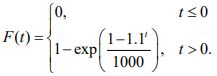
91. A man purchases a life insurance policy on his 40th birthday. The policy will pay 5000 if he dies before his 50th birthday and will pay 0 otherwise. The length of lifetime, in years from birth, of a male born the same year as the insured has the cumulative distribution function Calculate the expected payment under this policy. (A) 333 (B) 348 (C) 421 (D) 549 (E) 574
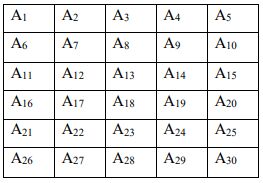
97. Thirty items are arranged in a 6-by-5 array as shown. Calculate the number of ways to form a set of three distinct items such that no two of the selected items are in the same row or same column. (A) 200 (B) 760 (C) 1200 (D) 4560 (E) 7200
 阿摩線上測驗
登入
 for 0 < x<∞ .

 percentile of losses that exceed the deductible. (A) 600 (B) 700 (C) 800 (D) 900 (E) 1000
 (B)
 (C)
 (D)
 (E)


 (B)
 (C)
 (D)e2 −1 (E)e2