所屬科目:Exam P:Probability機率
252. The independent random variables X and Y have the same mean. The coefficients of variation of X and Y are 3 and 4 respectively. Calculate the coefficient of variation of . (A) 5/4 (B) 7/4 (C) 5/2 (D) 7/2 (E) 7
255. A dental insurance company pays 100% of the cost of fillings and 70% of the cost of root canals. Fillings and root canals cost 50 and 500 each, respectively. The tables below show the probability distributions of the annual number of fillings and annual number of root canals for each of the company’s policyholders.Calculate the expected annual payment per policyholder for fillings and root canals. (A) 90.00 (B) 102.50 (C) 132.50 (D) 250.00 (E) 400.00
257. Let X be the percentage score on a college-entrance exam for students who did not participate in an exam-preparation seminar. X is modeled by a uniform distribution on [a, 100]. Let Y be the percentage score on a college-entrance exam for students who did participate in an exam-preparation seminar. Y is modeled by a uniform distribution on [1.25a, 100]. It is given that . Calculate the percentile of Y. (A) 80 (B) 85 (C) 90 (D) 92 (E) 95
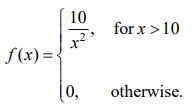
266. Claim amounts are independent random variables with probability density function Calculate the probability that the largest of three randomly selected claims is less than 25. (A)(B)(C)(D)(E)
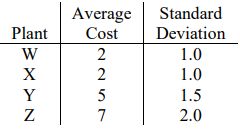
270. An industrial company provides health insurance to employees located at four different plants. Health insurance costs at each plant are independent of the costs at any other plant. Plant managers have calculated the following statistics: Calculate the standard deviation of total company health insurance costs. (A) 1.4 (B) 2.1 (C) 2.9 (D) 5.5 (E) 6.3
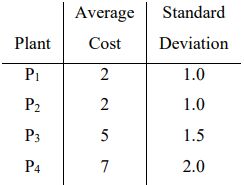
273. An industrial company provides health insurance to employees located at four different plants. Health insurance costs at each plant are independent of the costs at any other plant. Plant managers have calculated the following statistics: Calculate the standard deviation of total company health insurance costs. (A) 1.4 (B) 2.1 (C) 2.9 (D) 5.5 (E) 6.3
286, Losses follow an exponential distribution with mean 1. Two independent losses are observed. Calculate the probability that either of the losses is more than twice the other. (A)(B)(C)(D)(E)
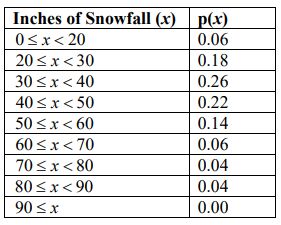
289. An airport owner purchases an insurance policy to offset costs associated with excessive amounts of snowfall. For every full ten inches of snow in excess of 40 inches during the winter season, the insurer pays the airport 200 up to a policy maximum of 500. The following table shows a probability function for the random variable X of winter season snowfall, in inches, at the airport. Calculate the standard deviation of the amount paid under the policy. (A) 163.5 (B) 187.6 (C) 208.7 (D) 234.9 (E) 336.6
290. Let be independent identically distributed random variables such that P[X=0]= P[X=2] =0.5. Let S= . Calculate the approximate value of P[S >115]. (A) 0.005 (B) 0.067 (C) 0.144 (D) 0.147 (E) 0.440
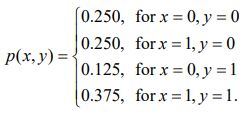
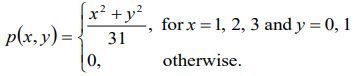
291. Let X and Y be discrete random variables with joint probability function Calculate Corr (X, Y), the correlation coefficient of X and Y. (A) 0.06 (B) 0.23 (C) 0.26 (D) 0.38 (E) 0.63
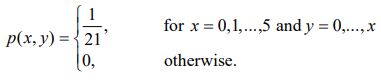
292. Let X and Y be discrete random variables with joint probability function Calculate the variance of Y. (A) 1.67 (B) 2.22 (C) 3.33 (D) 5.00 (E) 5.56
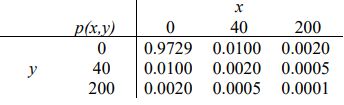
293. A company provides disability benefits to its employees. There are only two possible benefits: partial disability, costing the company 40, and total disability, costing the company 200. The company employs a number of married couples. Let (X,Y) denote the company's disability costs for a randomly selected employed married couple. The joint probability function for (X,Y) is: Calculate the standard deviation of the total disability cost X + Y for the married couple. (A) 12.3 (B) 13.8 (C) 15.7 (D) 16.6 (E) 19.8
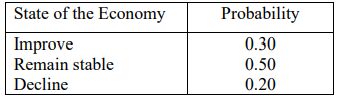
294. The probability that the economy will improve, remain stable, or decline is: Prices for Stock X and Stock Y will change as follows: Determine which of the following statements about the percentage price changes for Stock X and Stock Y is true. (A) The percentage change for Stock X has a larger variance and a larger mean. (B) The percentage change for Stock X has a larger variance and the means are equal. (C) The percentage change for Stock X has a larger variance and a smaller mean. (D) The variances are equal and the percentage change for Stock X has a larger mean. (E) Both the variances and the means are equal.
297. The lifetime of a machine part has a continuous distribution on the interval (0, 40) with probability density function f, where f (x) is proportional to . Calculate the probability that the lifetime of the machine part is less than five. (A) 0.03 (B) 0.13 (C) 0.42 (D) 0.58 (E) 0.97
298. The claim, X, for a dental insurance policy is a random variable with the following probability function:The premium for the policy is equal to 125% of the expected claim amount. Calculate the approximate probability that the total claims on 76 independent policies exceed the total premium collected. (A) 0.02 (B) 0.07 (C) 0.17 (D) 0.25 (E) 0.40
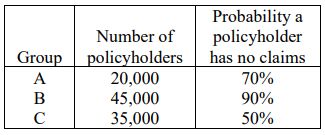
299. An insurance company categorizes its policyholders into three mutually exclusive groups. A study produced the following information: Within each group, the numbers of claims made by individual policyholders are mutually independent Poisson random variables. Calculate the expected total number of claims, in thousands, made by the 100,000 policyholders. (A) 21 (B) 28 (C) 36 (D) 64 (E) 72
302. The number of automobile accidents on any day in a city has a Poisson distribution with mean 4. The number of accidents on a given day is independent of the number of accidents on any other day. Calculate the probability that at most one accident occurs in a three-day period. (A)(B) (C) (D)(E)
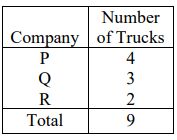
304. Companies P, Q, and R use routes that take their trucks through a common inspection checkpoint each day. The number of trucks for each company that pass the checkpoint each day is as follows: Calculate the probability that at least one of two randomly chosen trucks is from Company P. (A) 0.28 (B) 0.31 (C) 0.56 (D) 0.69 (E) 0.72
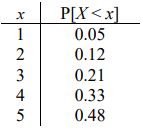
308. A life insurance policy pays 1000 upon the death of a policyholder provided that the policyholder survives at least one year but less than five years after purchasing the policy. Let X denote the number of years that a policyholder survives after purchasing the policy with the following probabilities: Calculate the standard deviation of the payment made under this policy. (A) 218 (B) 430 (C) 480 (D) 495 (E) 500
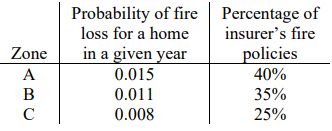
309. An insurer divides a city into three zones and assesses risks associated with fire loss as follows: Given that a fire loss occurs in a home covered by the insurer, calculate the probability that the home is in Zone A. (A) 0.349 (B) 0.400 (C) 0.441 (D) 0.465 (E) 0.506
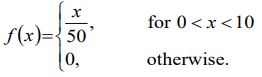
310. An insurer offers policies for which insured loss amounts follow a distribution with density function Customers may choose one of two policies. Policy 1 has no deductible and a limit of 4, while Policy 2 has a deductible of 4 and no limit. Given the occurrence of an insured loss, calculate the absolute value of the difference between the insurer’s expected claim payments under Policies 1 and 2. (A) 0.32 (B) 0.64 (C) 0.79 (D) 0.91 (E) 1.12
311. Employees of a large company all choose one of three levels of health insurance coverage, for which premiums, denoted by X , are 1, 2, and 3, respectively. Premiums are subject to a discount, denoted by Y, of 0 for smokers and 1 for non-smokers. The joint probability function of X and Y is given by Calculate the variance of X Y− , the total premium paid by a randomly chosen employee. (A) 0.20 (B) 0.69 (C) 0.74 (D) 1.90 (E) 2.65
315. The random variable characterizes an insurer's annual property losses, where X1 is normally distributed with mean 16 and standard deviation 1.50. Similarly, the random variable characterizes the insurer's annual liability losses, where X2 is normally distributed with mean 15 and standard deviation 2. The insurer's annual property losses are independent of its annual liability losses. Calculate the probability that, in a given year, the minimum of the insurer's property losses and liability losses exceeds . (A) 0.126 (B) 0.154 (C) 0.250 (D) 0.309 (E) 0.346
 阿摩線上測驗
登入
 . (A) 5/4 (B) 7/4 (C) 5/2 (D) 7/2 (E) 7

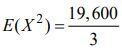 .
 percentile of Y. (A) 80 (B) 85 (C) 90 (D) 92 (E) 95
 (B)
 (C)
 (D)
 (E)

 (B)
 (C)
 (D)
 (E)

 be independent identically distributed random variables such that P[X=0]= P[X=2] =0.5. Let S=
 .

 .

 (B)
 (C)
 (D)
 (E)

 characterizes an insurer's annual property losses, where X1 is normally distributed with mean 16 and standard deviation 1.50. Similarly, the random variable
 characterizes the insurer's annual liability losses, where X2 is normally distributed with mean 15 and standard deviation 2.
 . (A) 0.126 (B) 0.154 (C) 0.250 (D) 0.309 (E) 0.346