所屬科目:研究所、轉學考(插大)-普通生物學
1. A newly synthesized protein destined for secretion from a eukaryotic cell will generally follow which of the pathways listed below? (A) rough ER → Golgi → transport vesicle → nucleus (B) Golgi → rough ER → lysosome → transport vesicle → plasma membrane (C) rough ER → Golgi → transport vesicle → plasma membrane (D) rough ER → lysosome → transport vesicle → plasma membrane
2. Which of the following structures form cytoplasmic channels that connect adjacent plant cells through the cell walls? (A) desmosomes (B) gap junctions (C) plasmodesmata (D) tight junctions
3. Which of the following statements best describes how unsaturated fatty acids increase membrane fluidity at lower temperatures? (A) The double bonds form kinks in the fatty acid tails, preventing adjacent lipids from packing tightly. (B) Unsaturated fatty acids have a higher cholesterol content, which prevents adjacent lipids from packing tightly. (C) Unsaturated fatty acids are more nonpolar than saturated fatty acids. (D) The double bonds block interaction among the hydrophilic head groups of the lipids.
4. Which of the following responses is stimulated by cell signaling the formation of biofilms? (A) formation of mating complexes (B) aggregation of bacteria (C) secretion of substances that inhibit the growth of foreign bacteria (D) inhibition of quorum sensing
5. Upon completion of the citric acid cycle, most of the energy originally stored in each glucose molecule catabolized by cellular respiration is stored in which of the following molecules? (A) acetyl-CoA (B) ATP (C) CO2 (D) NADH
6. On a spaceship designed to support a multiyear voyage to the outer planets of the solar system, plants will be grown to provide oxygen and to recycle carbon dioxide. Because the spaceship will be so far from the sun, an artificial light source will be needed to support photosynthesis. Which of the following wavelengths of light should be used to maximize plant growth? (A) a mixture of yellow and orange light (B) green light (C) a mixture of blue and red light (D) ultraviolet light
7. Which of the following statements describes a characteristic feature of metaphase? (A) alignment of chromosomes on the equator of the cell (B) separation of the centromeres (C) cytokinesis (D) separation of sister chromatids
8. How many unique gametes could be produced through independent assortment by an individual with the genotype AaBbCCDdEE? (A) 4 (B) 8 (C) 16 (D) 64
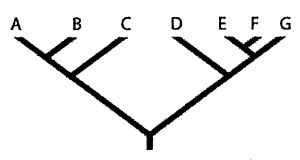
9. Use the following information to answer the question.
In the figure, the letters A-G represent individual species that all descended from a common ancestor. Which of the following groups of these species forms a monophyletic group? (A) A, B, C, D (B) C and D (C) D, E, and F (D) E, F, and G
10. Cystic fibrosis is a genetic disorder in humans where the person has two homozygous recessive alleles for the gene. If the disease is left untreated, it causes severe health problems in the individual. If 4 in 10,000 newborn babies have the disease, what are the expected frequencies of the dominant (A1) and recessive (A2) alleles according to the Hardy-Weinberg equation? (A) f(A1) = 0.9998, f(A2) = 0.0002 (B) f(A1) = 0.9800, f(A2) = 0.0200 (C) f(A1) = 0.9700, f(A2) = 0.0300 (D) f(A1) = 0.9604, f(A2) = 0.0392
11. Which of the following provides an example of mechanical isolation as a prezygotic barrier? (A) two species live in different habitats (B) two species mate at different times (C) two species share courtship activities (D) two snails have shells that spiral in different directions
12. Which of the following statements accurately describes the lysogenic cycle of lambda (λ) phage? (A) The viral genes immediately turn the host cell into a lambda-producing factory. Then the host lyses. (B) The product of one prophage gene is made and it activates most of the other prophage genes. (C) The phage genome is integrated into the host chromosome where it is passed on to daughter cells through binary fission. (D) The phage DNA is copied and accumulates in the cytoplasm. Then a trigger causes capsid proteins to be made and phages are assembled.
13. Which of the following statements correctly describes the colonization of terrestrial habitats by plants? (A) It occurred in conjunction with insects that pollinated them. (B) It occurred in conjunction with fungi that helped provide them with nutrients from the soil. (C) It helped them to escape abundant herbivores in the oceans. (D) It occurred only about 150 million years ago.
14. Which of the following functions is an advantage of seeds compared to spores? (A) using wind as a dispersal agent (B) containing a nutrient store for a developing sporophyte (C) relying on animals for pollination (D) providing nutrition for animals
15. In a field of corn or lettuce on a farm, plants are cultivated with uniform spacing that will maximize plant growth. In natural habitats, however, a uniform pattern of dispersion is much less common. While exceptions do exist, for example in populations of creosote bush in the desert, which of the following best explains why natural populations of plants usually exhibit clumped or random dispersion patterns? (A) Patterns of higher soil moisture, the concentration of soil nutrients, and the distribution of seeds from parent plants may be highly variable. (B) Precipitation across landscapes, especially mountain ranges, is uniform. (C) The competitive interactions between individuals of the same population usually lead to such dispersion patterns. (D) Since nearly all plants are wind-pollinated, the direction of breezes can affect whether plants will produce seeds.
1. Autotroph
2. Barr body
3. Biomass
4. Carbon fixation
5. Ecological succession
6. Epigenetics
7. Exon shuffling
8. Habituation
9. Osmosis
10. Pheromone
III. Assay questions1. What is our current understanding about the origin of mitochondria? What evidence supports this hypothesis?
2. What are the important processes during animal fertilization?
3. What are the major differences between C3, C4, and CAM photosynthesis?
 阿摩線上測驗
登入