所屬科目:研究所、轉學考(插大)◆電磁學
1. Which of the following statements is true? (A) Dynamic electromagnetic forces satisfy Newton's third law (B) Static electromagnetic forces satisfy momentum conservation (C) Given the electric field E = and charge q, the physical meaning of qA is energy. (D) All of the above are true
2. Which of the following cannot support TEM modes (ignoring the fringing effect): (A) Two-wire line (B) Rectangular waveguide (C) Coaxial cable/line (D) Microstrip line
3. Which of the following statements about the vector potential A is always true? (A) ∇ × A = B (B) ∇ · A = 0 (C) ∇²A = -μ₀J (D) None of the above
4. There is a dielectric-filled parallel-planar metallic waveguide oriented in the way that guided waves propagate along z direction, and the separation d of two parallel is along y axis. Ignoring the fringing effect, the following field component of fundamental mode supported by the waveguide is non-zero: (A) Ez (B) Ex (C) Hy (D) Hx
5. In the complex notation (also called the phasor notation), we can express a monochromatic plane wave as E = E₀ei(k·r-ωt). How do we calculate the time-averaged Poynting vector in this notation? (A) E × H (B) Re[E × H] (C) Re[E × H*] (D) None of the above
6. Consider a plane wave traveling in a lossy material. The electric field is given by E = E₀ei(kz-ωt), where k equals 1 + 0.1i (μm⁻¹). The intensity of the plane wave can be expressed as I = I₀e-αz, where α is the absorption coefficient. Please calculate α. (A) 2 (μm⁻¹) (B) 0.2 (μm⁻¹) (C) 0.1 (μm⁻¹) (D) None of the above
7. If A = r cosφ r̂ + sinφ φ̂, evaluate ∮ A · dl around the path shown in the following figure. (A) 0 (B)(C) (D) None of the above
8. The finite sheet 0 ≤ x ≤ 1 and 0 ≤ y ≤ 1 on the z = 0 plane has a surface charge density ρs = xy(x² + y² + 25)3/2 nC/m². Evaluate the electric field at (0, 0, 5).(A) -3 x̂ - 3 ŷ + 22.5 ẑ V/m (B) -3 x̂ - 3 ŷ + 11.25 ẑ V/m (C) -1.5 x̂ - 1.5 ŷ + 22.5 ẑ V/m (D) -1.5 x̂ - 1.5 ŷ + 11.25 ẑ V/m
9. In the following figure, two conducting cones of infinite extent with θ₁ and θ₂ are separated by an infinitesimal gap at R = 0. If 0 < θ₁ < θ₂ < , V(θ₁) = 0, and V(θ₂) = 10 V, evaluate the potential distribution V(θ) between the cones. (A) 10V (B) 10 V (C) 10 [ln(tan θ cot θ₁)] / [ln(tan θ₂ cot θ₁)] V (D) 10 [ln(tan 2θ cot 2θ₁)] / [ln(tan 2θ₂ cot 2θ₁)] V
10. Consider a plane wave that is incident obliquely on an interface between two dielectric media of refractive indices of nᵢ and nₜ, as shown in the figure. We express the incident wave and transmitted wave as Eᵢ = E₀ᵢe^{i(kᵢ·r-ωt)} and Eₜ = E₀ₜe^{i(kₜ·r-ωt)}, respectively. Here, kᵢ, kᵣ, and kₜ are the wave vectors of the incident wave, reflected wave, and transmitted wave, respectively. These wave vectors are all on the same plane. Which one of the following relations is correct? (A) kᵢcosθᵢ = kₜcosθₜ (B) kᵢsinθᵢ = kₜsinθₜ (C) kᵢnᵢsinθᵢ = kₜnₜsinθₜ (D) None of the above
11. Consider an ideal lossless transmission line with the characteristic impedance R₀ = 50 Ω. The transmission line is connected to a load which is composed of a resistor R = 25 Ω and a capacitor C = 0.2 pF in series. The signal frequency is at 10 GHz. If we want to use the Smith chart for determining the signal reflectivity at the load interface, please refer to the following figure and determine inside which quadrant (象限) of the Smith chart the data point will be located: (A) I (B) II (C) III (D) IV
12. A TE wave propagating in a dielectric-filled rectangular metallic waveguide of unknown permittivity has dimension a = 5 cm and b = 2 cm. If the x component of its electric field is given by Ex = -10 cos(40πx) sin(100πy) sin(2.4π × 10¹⁰t - 52.9πz) (V/m). Which following statement is correct: (A) The mode number is TE₂₃ (B) εᵣ of the filled dielectric material is 2 (C) The cutoff frequency of the TE mode is below 11 GHz (D) None of the above
13. The quality factor Q for a hollow resonant cavity operating in the TE₁₀₁ mode is about 6000, and the frequency of the TE₁₀₁ mode is 15 GHz. What is the bandwidth of the cavity at the TE₁₀₁ mode? (A) 2.50 MHz (B) 1.67 MHz (C) 1.33 MHz (D) None of the above
14. A disk of a surface charge density σ₀ and a radius a is on the x-y plane and spinning about its center with an angular velocity ω = ω₀ẑ. What is the B at its center? (A) 0 (B) (C)(D) None of the above
15. A wire is defined by the parametric equations: x = a cos u, y = a sin u, and z = a sin u for u in [0,2π]. A current I flows counterclockwise on the wire (top view, from +z to -z). What is the magnetic dipole moment of the wire? (A) Iπa²x̂ + Iπa²ẑ (B) -Iπa²ŷ + Iπa²ẑ (C) Iπa²ŷ + Iπa²ẑ (D) None of the above
16. A DC voltage source is connected across a long, straight conducting wire with radius a and conductivity σ carries a direct current I along the -z direction. Determine the Poynting vector on the surface of the wire associated with the electromagnetic fields. (A) (B) (C) (D)
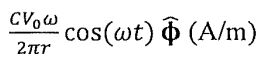
17. An AC voltage source V₀ sin(ωt) (V) is connected across a parallel-plate capacitor C. The capacitor has circular plates with a radius a. Determine the H at a distance r from the axis of the capacitor, where r < a. (A) (B) (C)(D)
18. Consider an ideal lossless coaxial cable transmission line. The dielectric material between the two conductors of the coaxial cable is with a dielectric constant ε = 2.25 ε₀. The cable is open-circuited at one end and is excited with a sinusoidal signal at 1 GHz from the other end. We want to determine at which position inside the cable, the root-mean-square (rms) of the net voltage will have the minimum value. If the distance between the nearest minimum rms voltage point and the open-circuited end is L, please determine which is the closest value for L among the following choices: (A) 4 cm (B) 5 cm (C) 6 cm (D) 7 cm
19. Consider an ideal lossless transmission line with the characteristic impedance R₀ = 100 Ω. A λ/8 section (β·l = π/4) of this transmission line is connected to a load with an impedance Z_L and the input impedance seen from the input end of the λ/8 (β·l = π/4) transmission line with the load is exactly Zᵢ = 50 Ω. Please determine which is the nearest value for the real part of the load impedance, Re[Z_L], among the following choices: (A) 50 Ω (B) 60 Ω (C) 70 Ω (D) 80 Ω
20. Consider a lossy distortionless transmission line. The characteristic impedance is 50 Ω, the phase velocity is 2 × 10⁸ m/s, and the operation frequency is 1 GHz. For the four transmission line parameters R, L, G, C of the distortionless transmission line, if we already know the value of R is 0.1 Ω/m and the signal voltage propagates in the z direction as V(z) = V(0)exp(-αz - jβz) without the reflected signal, please determine which is the nearest value for the ratio β/α among the following choices: (A) 10³ (B) 10⁴ (C) 10⁵ (D) 10⁶
 阿摩線上測驗
登入
 and charge q, the physical meaning of qA is energy. (D) All of the above are true
 Re[E × H*] (D) None of the above
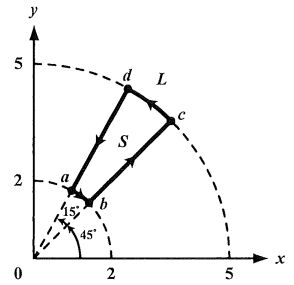 (A) 0 (B)
 (C)
 (D) None of the above
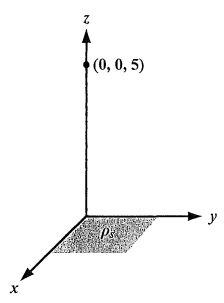 (A) -3 x̂ - 3 ŷ + 22.5 ẑ V/m (B) -3 x̂ - 3 ŷ + 11.25 ẑ V/m (C) -1.5 x̂ - 1.5 ŷ + 22.5 ẑ V/m (D) -1.5 x̂ - 1.5 ŷ + 11.25 ẑ V/m
 , V(θ₁) = 0, and V(θ₂) = 10 V, evaluate the potential distribution V(θ) between the cones.
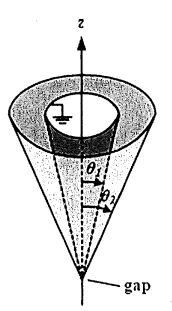 (A) 10
 V (B) 10
 V (C) 10 [ln(tan θ cot θ₁)] / [ln(tan θ₂ cot θ₁)] V (D) 10 [ln(tan 2θ cot 2θ₁)] / [ln(tan 2θ₂ cot 2θ₁)] V
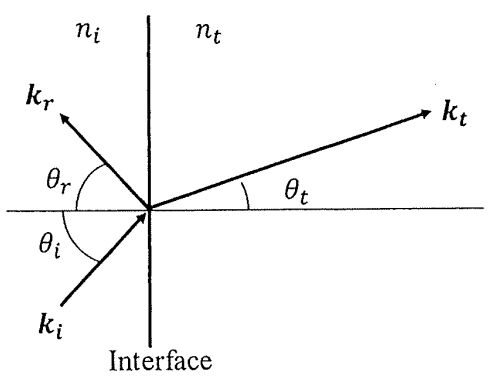 (A) kᵢcosθᵢ = kₜcosθₜ (B) kᵢsinθᵢ = kₜsinθₜ (C) kᵢnᵢsinθᵢ = kₜnₜsinθₜ (D) None of the above
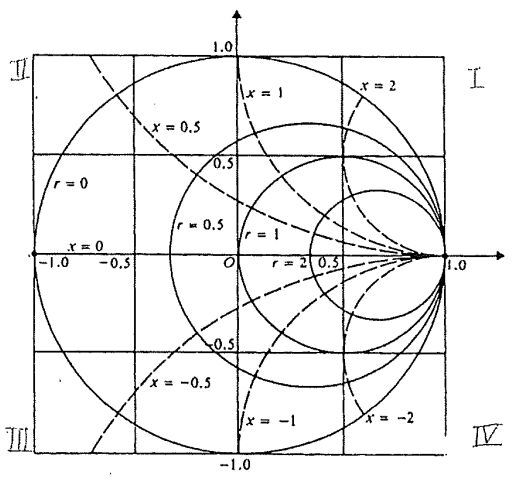 (A) I (B) II (C) III (D) IV
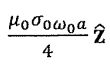 (C)
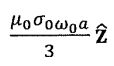 (D) None of the above
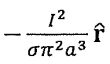 (B)
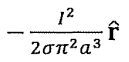 (C)
 (D)
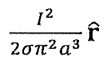
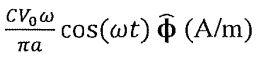 (B)
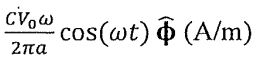 (C)
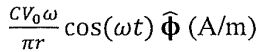 (D)