所屬科目:研究所、轉學考(插大)◆電磁學
1. If $\mathbf{A} = r \cos \phi \hat{\mathbf{r}} + \sin \phi \hat{\boldsymbol{\Phi}}$, evaluate $\nabla \cdot (\nabla \times \mathbf{A})$ for $r > 0$. (A) 0 (B) 1 (C) $r$ (D) None of the above.
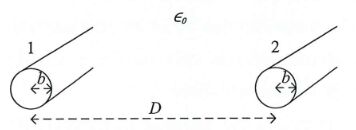
2. An isolated two-wire transmission line in free space consists of two long, parallel conductors, each of radius $b$, separated by a center-to-center distance $D$, where $D \gg b$. A potential difference $V_{0}$ is applied between the two wires, and the surface charge on each conductor may be approximated as uniformly distributed. Find the magnitude of the electrostatic force per unit length between the wires. (A) $\frac{\pi \epsilon_0 V_0^2}{2 \left( \frac{D}{b} \right)}$ (B) $\frac{\pi \epsilon_0 V_0^2}{2 \left( \frac{D}{b} \right)^2}$ (C) $\frac{\pi \epsilon_0 V_0^2}{2D \left[ \ln \left( \frac{D}{b} \right) \right]}$ (D) $\frac{\pi \epsilon_0 V_0^2}{2D \left[ \ln \left( \frac{D}{b} \right) \right]^2}$
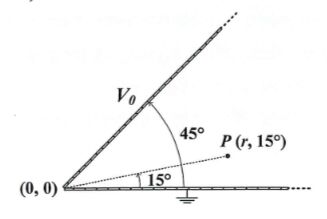
3. Two infinitely extended conducting planes physically meet at the origin and form a wedge of opening angle $45^{\circ}$. Although they touch geometrically, the two planes are electrically insulated from each other so that each can be maintained at an independent constant potential. One plane is held at potential $0$, and the other is held at potential $V_{0}$. Determine the electrostatic potential at a point $P$ located inside the wedge at angular position $15^{\circ}$ (for any $r > 0$). (A) $\frac{V_0}{\sqrt{3}}$ (B) $\frac{V_0}{3}$ (C) $\frac{V_0}{\sqrt{3}r}$ (D) $\frac{V_0}{3r}$
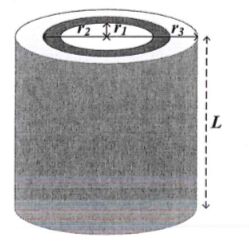
4. A DC voltage $V_{0}$ is applied across a cylindrical capacitor of length $L$. The inner conductor has radius $r_{1}$, and the outer conductor has radius $r_{3}$. The space between the conductors is filled with two different lossy dielectric materials. In the region $r_{1} < r < r_{2}$, the material has permittivity $\epsilon_{1}$ and conductivity $\sigma_{1}$. In the region $r_{2} < r < r_{3}$, the material has permittivity $\epsilon_{2}$ and conductivity $\sigma_{2}$. Assuming steady-state conditions and cylindrical symmetry, determine the current density throughout the region $r_{1} < r < r_{3}$. (A) $\frac{V_0}{r\left[\frac{1}{\sigma_1} \ln\left(\frac{r_3}{r_2}\right) + \frac{1}{\sigma_2} \ln\left(\frac{r_2}{r_1}\right)\right]} \hat{r}$ (B) $\frac{V_0}{r\left[\frac{1}{\sigma_1} \ln\left(\frac{r_3}{r_2}\right) - \frac{1}{\sigma_2} \ln\left(\frac{r_2}{r_1}\right)\right]} \hat{r}$ (C) $\frac{V_0}{r\left[\frac{1}{\sigma_1} \ln\left(\frac{r_2}{r_1}\right) + \frac{1}{\sigma_2} \ln\left(\frac{r_3}{r_2}\right)\right]} \hat{r}$ (D) $\frac{V_0}{r\left[\frac{1}{\sigma_1} \ln\left(\frac{r_2}{r_1}\right) - \frac{1}{\sigma_2} \ln\left(\frac{r_3}{r_2}\right)\right]} \hat{r}$
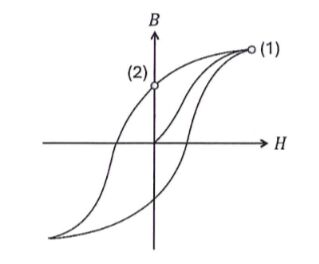
5. Which of the following statements about the hysteresis curve below is correct? (A) The magnetization behavior of a magnetic material depends only on the externally applied magnetic field. (B) At point (1), the magnetic material is fully de-magnetized. (C) At point (2), residual magnetic field is left in the magnetic material even without the presence of external magnetic field. (D) None of the above is correct.
6. An infinitely long, straight conducting wire with a circular cross section of radius $b$ carries a steady current $I$ that is flowing upward (along the $\hat{\mathbf{z}}$ direction). Which of the following statements is correct? (A) Viewing from the top the magnetic field $\pmb{B}$ is circulating clockwise around the wire. (B) Inside the wire, the magnitude of the magnetic field $|\pmb{B}|$ at a point of interest scales linearly with the distance of that point away from the center of the wire. (C) Outside the wire, the magnitude of the magnetic field $|\pmb{B}|$ at a given point decreases with the square of its distance from the center of the wire. (D) None of the above is correct.
7. A metal bar slides over a pair of conducting rails in a uniform magnetic field $\mathbf{B} = B_{0}\hat{\mathbf{z}}$ with a constant velocity $\mathbf{u}$. A load with resistance of $R$ is connected to nodes 1 and 2. Which of the following statements is correct? (A) Each electron in the moving bar experiences a unit force that has a magnitude of $|\mathbf{u}|B_0$ and is pointing in the $-y$ direction. (B) Before connecting the load, an open-circuit voltage $V_{0} = -|\mathbf{u}|B_{0}h$ is generated. (C) After connecting the load, the current will flow counterclockwise. (D) None of the above.
8. Which of the following equations describes charge conservation? (A) $\nabla \times \mathbf{E} = -\frac{\partial \mathbf{B}}{\partial t}$ (B) $\nabla \cdot \mathbf{D} = \rho$ (C) $\nabla \times \mathbf{H} = \mathbf{J} + \frac{\partial \mathbf{D}}{\partial t}$ (D) $\nabla \cdot \mathbf{J} = -\frac{\partial \rho}{\partial t}$
9. For electromagnetic waves propagating in conductors, we can derive the modified wave equation: $$ \nabla^{2} \mathbf{E} - \mu \epsilon \frac{\partial^{2} \mathbf{E}}{\partial t^{2}} - \mu \sigma \frac{\partial \mathbf{E}}{\partial t} = 0 $$ Consider a monochromatic plane wave as $\mathbf{E} = \mathbf{E}_0 e^{i(kz - \omega t)}$, where the wave number $k$ is a complex number. Please derive the expression for the wave number $k$. (A) $\omega \sqrt{\mu \epsilon} \left(1 + \frac{i\sigma}{\omega \epsilon}\right)^{\frac{1}{2}}$ (B) $i\omega \sqrt{\mu \epsilon} \left(1 + \frac{\sigma}{\omega \epsilon}\right)$ (C) $\omega \sqrt{\mu \epsilon} \left(1 + \frac{\omega \epsilon}{i\sigma}\right)^{1/2}$ (D) None of the above.
10. For plane electromagnetic waves propagating in vacuum, which one of the following descriptions is incorrect? Here $\mathbf{k}$ is the wave vector, and $\mathbf{S}$ is the Poynting vector. (A) $\mathbf{k} \perp \mathbf{E}$ (B) $\mathbf{S} \perp \mathbf{k}$ (C) $\mathbf{E} \perp \mathbf{H}$ (D) None of the above.
11. Consider a plane electromagnetic wave propagating in vacuum. The electric field is given by $\mathbf{E} = \mathbf{E}_0 e^{i(kx - \omega t)}$. The Poynting vector is labeled by $\mathbf{S}$. The intrinsic impedance $\eta$ (also called wave impedance) is $377\ \Omega$. The time-averaged Poynting vector $\langle S \rangle$ is $1\ \mathrm{W/m^2}$. Please calculate $E_0$, i.e., the amplitude of the electric field. Please choose the closest answer. (A) $54.2\ \mathrm{V/m}$ (B) $377\ \mathrm{V/m}$ (C) $19.4\ \mathrm{V/m}$ (D) $27.5\ \mathrm{V/m}$
12. Consider a plane electromagnetic wave expressed by its phasor form of $\mathbf{E} = \mathbf{E}_0 e^{i(k_x x + k_y y + k_z z)}$. The expression should satisfy the Helmholtz equation: $\nabla^2 \mathbf{E} + \omega^2 \mu \epsilon \mathbf{E} = 0$. As a result, which one of the following relations must be true? (A) $k_x + k_y + k_z = \omega \sqrt{\mu \epsilon}$ (B) $k_x^2 + k_y^2 + k_z^2 = \omega^2 \sqrt{\mu \epsilon}$ (C) $k_x^2 + k_y^2 + k_z^2 = \omega^2 \mu \epsilon$ (D) None of the above.
13. What is the short-circuit impedance measured at the input terminals of an infinitely long transmission line with the parameters of $(R = 45 \times 10^{-3}\ \Omega/\mathrm{m}, L = 27 \times 10^{-8}\ \mathrm{H/m}, G = 5 \times 10^{-5}\ \mathrm{S/m}, C = 3 \times 10^{-10}\ \mathrm{F/m})$ at $5\ \mathrm{GHz}$? (A) $30\ \Omega$ (B) $50\ \Omega$ (C) $75\ \Omega$ (D) None of the above.
14. An 1-GHz voltage source $(V_{s})$ is applied to a short-circuit quarter-wavelength lossless transmission line as the figure shown below. The characteristic impedance of the transmission line is $20\Omega$. Please evaluate the current of $I_{x}$. (A) $0.25\mathrm{A}$ (B) $0.25\angle 90^{\circ}\mathrm{A}$ (C) $0.25\angle 270^{\circ}\mathrm{A}$ (D) None of the above.
15. Please select the closest dB value of the reflection coefficient of a $75 - \Omega$ resistive load in a $50 - \Omega$ system $Z_{0}$. (A) $-6.9\mathrm{dB}$ (B) $-13.9\mathrm{dB}$ (C) $-1.39\mathrm{dB}$ (D) None of the above.
16. A 5-V dc voltage with $25 - \Omega$ source resistance is applied at $t = 0$ to the input terminal of a $25 - \Omega$ terminated lossless coaxial of $30\mathrm{m}$ length as the figure below. The initial condition of voltage and current of the cable are $0\mathrm{V}$ and $0\mathrm{A}$. The dielectric constant $(\varepsilon_{\mathrm{r}})$ of the insulating material in the cable is 4, and the characteristic impedance of the cable $(Z_0)$ is $50\Omega$. Please select the closest voltage value at $V_{L}$ at 1s. (A) $5\mathrm{V}$ (B) $2.5\mathrm{V}$ (C) $7.5\mathrm{V}$ (D) None of the above.
17. A guided TE mode of frequency $15\mathrm{GHz}$ is excited and propagates in metallic waveguide filled with polyethylene, of which $\varepsilon_{r} = 2.25$. The waveguide is designed with dimensions $a = 2\mathrm{cm}$ (x axis) and $b = 1\mathrm{cm}$ (y axis). If the x component of its electric field is given by $$ E _ {x} = - 5 0 \cos (5 0 \pi x) \sin (1 0 0 \pi y) e ^ {- j \beta z} \mathrm {V / m} $$ Which of the following statements is NOT correct? (A) The mode number is $\mathrm{TE}_{11}$. (B) The guide wavelength is $1.33 \times 10^{-2} \mathrm{~m}$. (C) The cutoff frequency is smaller than $12\mathrm{GHz}$. (D) $E_{z}$ is zero.
18. Which of the following modes is the dominant mode in an air-filled metallic rectangular resonator for $a > b > d$? where $a, b,$ and $d$ are the dimensions in the x-, y-, and z-directions in respective, and the mode number are $m, n,$ and $p$ accordingly. Hint: Here we choose z-axis as the reference "the longitudinal direction" to define TE modes $(E_z = 0)$ and TM modes $(H_z = 0)$.  (A) $\mathrm{TM}_{110}$ (B) $\mathrm{TM}_{101}$ (C) $\mathrm{TE}_{101}$ (D) $\mathrm{TE}_{011}$
19. A parallel-plate waveguide made of perfectly conducting plates spaced $3\mathrm{cm}$ apart by polyethylene, $\varepsilon_{r} = 2.25$, is operated at frequency of $12\mathrm{GHz}$. Without considering the fringing effect on edges, which of the following supported modes has faster group velocity than others: (A) $\mathrm{TE}_3$ (B) $\mathrm{TM}_2$ (C) $\mathrm{TE}_1$ (D) TEM
20. An engineer intends to design a cubic cavity with side lengths $a = b = d = 25 \mathrm{~mm}$. To achieve the highest possible Q factor, he is evaluating three candidate materials—copper, aluminum, and silver—with electrical conductivities of $\sigma = 5.8 \times 10^{7} \mathrm{~S} / \mathrm{m}, \sigma = 3.5 \times 10^{7} \mathrm{~S} / \mathrm{m}, \sigma = 6.2 \times 10^{7} \mathrm{~S} / \mathrm{m}$, respectively. Which material should be chosen when only conductivity is considered: (A) Copper (B) Aluminum (C) Silver (D) All have the same Q factor.
 阿摩線上測驗
登入
 (A) $\frac{\pi \epsilon_0 V_0^2}{2 \left( \frac{D}{b} \right)}$ (B) $\frac{\pi \epsilon_0 V_0^2}{2 \left( \frac{D}{b} \right)^2}$ (C) $\frac{\pi \epsilon_0 V_0^2}{2D \left[ \ln \left( \frac{D}{b} \right) \right]}$ (D) $\frac{\pi \epsilon_0 V_0^2}{2D \left[ \ln \left( \frac{D}{b} \right) \right]^2}$
 (A) $\frac{V_0}{\sqrt{3}}$ (B) $\frac{V_0}{3}$ (C) $\frac{V_0}{\sqrt{3}r}$ (D) $\frac{V_0}{3r}$
 (A) $\frac{V_0}{r\left[\frac{1}{\sigma_1} \ln\left(\frac{r_3}{r_2}\right) + \frac{1}{\sigma_2} \ln\left(\frac{r_2}{r_1}\right)\right]} \hat{r}$ (B) $\frac{V_0}{r\left[\frac{1}{\sigma_1} \ln\left(\frac{r_3}{r_2}\right) - \frac{1}{\sigma_2} \ln\left(\frac{r_2}{r_1}\right)\right]} \hat{r}$ (C) $\frac{V_0}{r\left[\frac{1}{\sigma_1} \ln\left(\frac{r_2}{r_1}\right) + \frac{1}{\sigma_2} \ln\left(\frac{r_3}{r_2}\right)\right]} \hat{r}$ (D) $\frac{V_0}{r\left[\frac{1}{\sigma_1} \ln\left(\frac{r_2}{r_1}\right) - \frac{1}{\sigma_2} \ln\left(\frac{r_3}{r_2}\right)\right]} \hat{r}$
 (A) The magnetization behavior of a magnetic material depends only on the externally applied magnetic field. (B) At point (1), the magnetic material is fully de-magnetized. (C) At point (2), residual magnetic field is left in the magnetic material even without the presence of external magnetic field. (D) None of the above is correct.
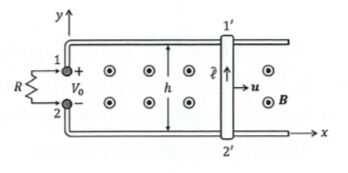 (A) Each electron in the moving bar experiences a unit force that has a magnitude of $|\mathbf{u}|B_0$ and is pointing in the $-y$ direction. (B) Before connecting the load, an open-circuit voltage $V_{0} = -|\mathbf{u}|B_{0}h$ is generated. (C) After connecting the load, the current will flow counterclockwise. (D) None of the above.
 (A) $0.25\mathrm{A}$ (B) $0.25\angle 90^{\circ}\mathrm{A}$ (C) $0.25\angle 270^{\circ}\mathrm{A}$ (D) None of the above.
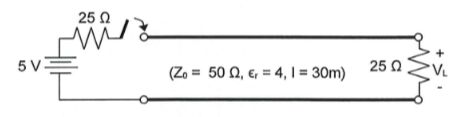 (A) $5\mathrm{V}$ (B) $2.5\mathrm{V}$ (C) $7.5\mathrm{V}$ (D) None of the above.