 阿摩線上測驗
37 許多研究顯示,病態性格者(psychopaths)在多少歲左右時,犯罪行為的發生比率就明顯下降?
(A) 20
(B) 30
(C) 40
(D) 50
統計: A(32), B(62), C(353), D(86), E(0) #1940964
詳解 (共 3 筆)

我不曉得用APD去定義psychopath合不合適,
在我理解來說,兩者可能有類似的特質但不是相同的東西。
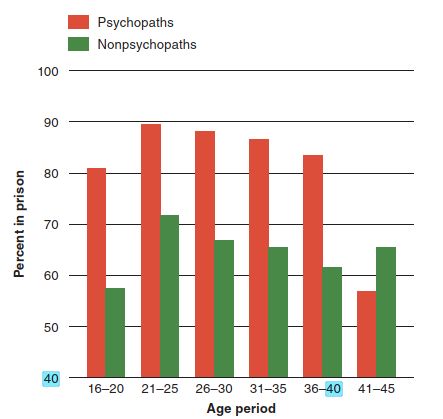
這題應該是出自Barlow變心的內容(他應該就是考底下那張圖),不是DSM-5。 DSM-5引用的可能是Hare他們的研究,
來說明反社會行為(更精確來說是犯罪行為)與年齡的關聯,
但主要還是要回到原本的文獻看他說了什麼。
-----------------
原文:
As children move into adulthood, the forms of antisocial behaviors change
—from truancy and stealing from friends to extortion, assaults,
armed robbery, or other crimes. Fortunately, clinical lore,
as well as scattered empirical reports (Robins, 1966),
suggest that rates of antisocial behavior begin to decline
rather markedly around the age of 40.
In their classic study, Hare, McPherson, and Forth (1988) provided
empirical support for this phenomenon.
They examined the conviction rates of male psychopaths and male
nonpsychopaths who had been incarcerated for a variety of crimes.
The researchers found that between the ages of 16 and 45
the conviction rates of nonpsychopaths remained relatively constant.
In contrast, the conviction rates of psychopaths remained relatively
constant up until about 40, at which time they decreased markedly
(see E Figure 12.2 下圖).
Why antisocial behavior often declines around middle age
remains unanswered (Hare et al., 2012).
------------------
參考書籍與頁數:Barlow, D. H., Durand, V. M., & Hofmann, S. G. (2018).
Abnormal psychology: An integrative approach. 8E,
Ch12. Personality disorders, p467(developmental influences)

正確答案是 (C) 40。
根據文獻指出,病態性格(psychopathy)通常被視為一種穩定的、年復一年幾乎沒有什麼改變的人格型態,但是病態性格者的犯罪活動大約在 40 歲左右時會呈現下降的趨勢(decreases around the age of 40)。
不過文獻也補充說明,目前學界尚不清楚這種犯罪行為的減少,究竟是因為他們變得更狡猾、學會了如何避免被逮捕,還是其行為真的發生了實質的改變。與此同時,被診斷為反社會人格障礙症(APD)的患者,其反社會行為與犯罪行為通常也會在變老時(通常也是在 40 歲左右)變得較不明顯或緩解。[Andrews 犯罪行為_Ch06_反社會人格型態]