阿摩線上測驗
登入
首頁
>
研究所、轉學考(插大)◆動力學
>
110年 - 110 國立臺灣大學_碩士班招生考試_應用力學研究所甲組:動力學(B)#100852
> 申論題
題組內容
2.(25%) Consider a billiard ball of radius r and mass m in contact with the flat surface of a table.
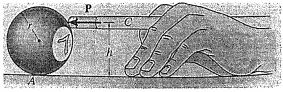
(i) The moment of inertia of the ball is 2mr
2
/5. Please derive it. (10%)
相關申論題
(i) Please find the angular acceleration of the bar AB. (12%)
#422452
(ii) Find the angular acceleration of the bar BC. (13%)
#422453
(ii) Determine the height h at which the ball must be struck so that no frictional force develops between it and the table at A. Assume that the cue C only exerts a horizontal force P on the ball.(15%)
#422455
3. (25%) A homogeneous sphere of mass m and radius r falls without rotation upon a fixed and perfectly rough surface inclined at an angle o to the horizontal plane. The vertical velocity before impact is Vo, and the coefficient of restitution for the collision is e. Determine the angular velocity of the sphere, the velocity, and the direction of motion of the center of mass of the sphere after the impact. (The moment of inertia of the sphere is )
#422456
4. (25%) A cannon in a fort at height h from the sea level overlooking the ocean fires a shell of mass m at an angle of θand muzzle velocity vo. See the figure below. At the highest point the shell explodes, with additional energy Ea, into two fragments with equal mass, travelling in the original horizontal direction. Neglect the air drag. Find the distance separating the two fragments when they land into the ocean.
#422457
(D) Species C is adsorbed on the catalyst at 700 K:(1) Ture, (2) False), (3) Cannot tell (3%)
#483401
(C)Species C is adsorbed on the catalyst surface at 400 K:(1) Ture,(2) False), (3) Cannot tell (3%)
#483400
(B) The reaction is endothermic: (1) Ture, (2) False), (3) Cannot tell (3%)
#483399
(A) The reaction is exothermic: (1) Ture, (2) False), (3) Cannot tell (3%)
#483398
7. (11%) In an ammonia decomposition reaction to generate N2 and H2 on a Platinum catalyst (2NH3 → N2 + 3H2) the rate can be expressed as -r = kKAPA/KHPH, where k is the rate constant, PA and PH indicate the pressures of ammonia and hydrogen, and KA and KH are the adsorption constants for ammonia and hydrogen. Suggest a mechanism and the assumptions consistent with the rate equation and prove it.
#483397
相關試卷
110年 - 110 國立臺灣科技大學_碩士班招生試題_化學工程系:化工熱力學與動力學#113043
110年 · #113043
110年 - 110 國立臺北科技大學_碩士班招生考試_車輛工程系:動力學#107823
110年 · #107823
110年 - 110 國立中山大學碩士暨碩士專班招生考試_機電系碩士班/丁組:動力學#104255
110年 · #104255
110年 - 110 國立中央大學_碩士班招生考試_機械工程學系/固定與設計組(一般生):動力學#103872
110年 · #103872
110年 - 110 國立臺灣大學_碩士班招生考試_機械工程研究所固體力學、系統控制組:動力學(A)#100865
110年 · #100865
110年 - 110 國立臺灣大學_碩士班招生考試_應用力學研究所甲組:動力學(B)#100852
110年 · #100852
110年 - 110 國立臺灣大學_碩士班招生考試_工程科學及海洋工程學研究所丙組:動力學(C)#100778
110年 · #100778
110年 - 110 國立臺灣大學_碩士班招生考試_機械工程研究所機械設計組:動力學(D)#100707
110年 · #100707