所屬科目:研究所、轉學考(插大)◆普通化學
1. Boron consists of two naturally occurring isotopes, ¹⁰B and ¹¹B. Bromine also has two naturally occurring isotopes, ⁷⁹Br and ⁸¹Br. How many molecular-ion peaks would be expected in the mass spectrum of BBr₃? (A) 2 (B) 4 (C) 6 (D) 8 (E) 12
2. A balloon has a volume of 3.02 L at 27°C. The balloon is heated to 127°C at constant pressure. What is the new volume of the balloon? (A) 2.82 L (B) 3.27 L (C) 4.03 L (D) 4.88 L (E) 14.2 L
3. For the following hypothetical reactions,
I. A₂(g) + B₂(g) ⇌ 2AB(g) K_I = 10²
II. 2A₂(g) + C₂(g) ⇌ 2A₂C(g) K_II = 10⁻⁴
III. A₂C(g) + B₂(g) ⇌ 2AB(g) + 1/2 C₂(g) What is the equilibrium constant, K, for reaction III? (A) 10⁻² (B) 10² (C) 10⁴ (D) 10⁶ (E) 10⁸
4. Nitrogen gas reacts with hydrogen gas to form ammonia:
N₂(g) + 3H₂(g) ⇌ 2NH₃(g) At 200°C in a rigid container, 1.2 atm of N₂ and 2.3 atm of H₂ are mixed. At equilibrium, the total pressure is 2.1 atm. What is the equilibrium partial pressure of H₂? (A) 0.92 atm (B) 0.20 atm (C) 1.2 atm (D) 1.8 atm (E) 0.35 atm
5. According to the Brønsted-Lowry definition, an acid is (A) a substance that increases the hydrogen ion concentration in solution. (B) a substance that increases the hydroxide ion concentration in solution. (C) a substance that can donate a proton to another species. (D) a substance that can accept a proton from another species. (E) an electron pair acceptor.
6. Which of the following 0.01 M aqueous solutions has the highest pH value? (A) HOAc (B) NaHCO₃ (C) H₂CO₃ (D) NaOAc (E) Na₂CO₃
7. Consider a solution of 2.0 M HCN (K_a = 6.2 × 10⁻¹⁰) and 1.0 M NaCN. Which statement is true? (A) The solution is not a buffer because [HCN] is not equal to [CN⁻]. (B) The buffer is more resistant to pH changes from added strong acid than from added strong base. (C) [OH⁻] > [H⁺] (D) The pH is below 7.00 because the concentration of the acid is greater than that of the base. (E) All of these statements are false.
8. At constant pressure, the reaction 2 NO₂(g) → N₂O₄(g) is exothermic. The reaction, as written, is (A) spontaneous at high temperatures but not at low temperatures. (B) spontaneous at low temperatures but not at high temperatures. (C) always spontaneous. (D) never spontaneous. (E) not possible to determine the spontaneity from the information given.
9. A calorimeter contains 95 g of water at 25.0°C. A 5.0 g sample of ice at -5.0°C is added, and eventually all the ice melts. Calculate the final temperature of the water. Assume no heat is lost to the calorimeter or the surroundings. The specific heat capacities for water and ice are 4.200 and 2.060 J g⁻¹°C⁻¹, respectively. The heat of fusion of ice is 334 J/g. (A) 19.6°C (B) 17.5°C (C) 20.7°C (D) 21.2°C
10. When 1.00 mol of a pure liquid is vaporized at a constant pressure of 1.00 atm and at its boiling point of 320.0 K, 28.80 kJ of heat is absorbed, and the volume change is +24.90 L. What is ΔE for this process? (A) -31.32 kJ (B) +31.32 kJ (C) -26.28 kJ (D) +26.28 kJ
11. Consider the freezing of liquid water at -10°C and constant pressure. For this process, what are the signs of ΔH, ΔS, and ΔG, respectively? (A) -, -, - (B) +, -, - (C) -, +, - (D) -, +, 0 (E) +, -, 0
12. An aqueous solution of an unknown ruthenium salt is electrolyzed by a current of 2.50 A for 50.0 min. If 2.618 g Ru is produced at the cathode, what is the charge on the ruthenium ion in solution? (A) 1+ (B) 2+ (C) 3+ (D) 4+ (E) 6+
13. Which of the following sets of quantum numbers is not allowed? The values are listed in the order (n, l, ml, ms). (A) 4, 1, 1, +1/2 (B) 4, 0, 0, -1/2 (C) 3, 1, 0, +1/2 (D) 5, 3, 1, -1/2 (E) 3, 3, 0, -1/2
14. The ionization energy of a hydrogen atom is 1.31 × 10⁶ J/mol. What is the ionization energy of He⁺? (A) 8.72 × 10⁻¹⁸ J/mol (B) 2.63 × 10⁶ J/mol (C) 5.25 × 10⁶ J/mol (D) 2.18 × 10⁻¹⁸ J/mol (E) 1.31 × 10⁶ J/mol
15. Which of the following species has the smallest radius? (A) Se²⁻ (B) Sr²⁺ (C) Br⁻ (D) Kr (E) Rb⁺
16. What is the hybridization of the central atom in SF₆? (A) sp (B) sp² (C) sp³ (D) dsp³ (E) d²sp³
17. The molecular orbital configuration (σ₂s)²(σ₂s*)²(π₂py)¹(π₂px)¹ corresponds to the ground state of which species? (A) Be₂ (B) Li₂⁺ (C) B₂ (D) B₂²⁻ (E) C₂
18. Most valence electron transitions occur in the _ region of the electromagnetic spectrum. Rotational transitions are typically induced by radiation in the region, and vibrational transitions are typically induced by radiation in the _ region. (A) X-ray, UV-vis, IR (B) UV-vis, IR, microwave (C) IR, microwave, UV-vis (D) Microwave, X-ray, UV-vis (E) UV-vis, microwave, IR
19. Raw milk sours in 4.0 h at 28°C but takes 48 h to sour in a refrigerator at 5°C. Calculate the activation energy for the souring of milk. (A) 8.87 kJ/mol (B) 4.00 kJ/mol (C) 12.0 kJ/mol (D) 75.2 kJ/mol
20. In a cubic closest-packed solid, what percentage of the space is occupied by the spheres? (A) 43.8% (B) 52.4% (C) 68.0% (D) 74.0% (E) 84.0%
21. In the unit cell of sphalerite, Zn²⁺ ions occupy half of the tetrahedral holes in a face-centered cubic lattice of S²⁻ ions. How many formula units of ZnS are present in one unit cell? (A) 1 (B) 2 (C) 3 (D) 4 (E) 5
22. A 4.0 g sample of solid NaOH is dissolved in enough water to prepare 1.0 L of aqueous solution. What is the approximated osmotic pressure of this solution at 25°C? (A) 2.1 atm (B) 2.4 atm (C) 3.6 atm (D) 4.4 atm (E) 4.9 atm
23. Arrange the following compounds in order of increasing boiling point: SnCl₄, SnBr₄, and SnI₄. (A) SnCl₄ < SnBr₄ < SnI₄. (B) SnI₄ < SnBr₄ < SnCl₄. (C) SnBr₄ < SnI₄ < SnCl₄. (D) SnCl₄ < SnI₄ < SnBr₄. (E) SnI₄ < SnCl₄ < SnBr₄.
24. Which of the following coordination compounds forms a precipitate when treated with aqueous AgNO₃? (A) Na₃[CrCl₆] (B) [Cr(NH₃)₃Cl₃] (C) Na₃[Cr(CN)₅Cl] (D) [Cr(NH₃)₆]Cl₃
25. How many isomers does C₃H₆Br₂ have? Count enantiomers separately. (A) 2 (B) 3 (C) 4 (D) 5 (E) 6
26. Which of the following statements about isotopes are correct? (A) Different isotopes of the same element contain different numbers of electrons. (B) The mass number of an isotope equals the total number of protons and neutrons in its nucleus. (C) The atomic masses of carbon-12 and carbon-13 are exactly 12 u and 13 u, respectively. (D) The atomic mass listed for an element in the periodic table is a weighted average of the masses of its naturally occurring isotopes. (E) Isotopes are represented by a subscript mass number to the left of the element symbol, for example, ²³⁵U.
27. Which of the following oxidation-number assignments are entirely correct? (A) Hydrogen: 0 in H₂, +1 in H₂O, and -1 in LiAlH₄. (B) Nitrogen: -3 in NH₃, -1 in N₂O, and +4 in NO₂. (C) Oxygen: 0 in O₃, -1 in K₂O₂, and -2 in H₂O. (D) Sulfur: 0 in S₈, -2 in Na₂S, and +4 in SO₃²⁻. (E) Bromine: 0 in Br₂(l), -1 in NaBr, and +5 in HBrO₃.
28. Which of the following statements about ideal gases and real gases are correct? (A) The assumptions of the ideal-gas model include negligible molecular volume and the absence of intermolecular forces. (B) The molar volume of an ideal gas is about 22.4 L/mol at standard temperature and pressure (STP), where STP corresponds to 1 atm and 25°C. (C) For a fixed amount of gas in a rigid container, the pressure approximately doubles when the temperature increases from 100°C to 200°C. (D) Neon behaves more ideally than ammonia under the same conditions. (E) The lower the pressure and the lower the temperature, the more closely a real gas approaches ideal-gas behavior.
29. Which of the following statements regarding the reaction quotient (Q) and equilibrium constant (K) are correct? (A) K is never smaller than Q. (B) For a reversible reaction in a closed system, Q gradually approaches K as equilibrium is established. (C) If Q > 1, the reaction always proceeds in the reverse direction. (D) If K > Q, the reaction proceeds in the forward direction to reach equilibrium. (E) At constant temperature, Q may change with time while K remains constant.
30. The pH of an aqueous solution at 25°C is raised from 2.0 to 5.0. Which statements are true? (A) The final [OH⁻] is 1 × 10⁻⁹ M. (B) The [H⁺] decreases by a factor of 30. (C) The initial solution could be 0.010 M CH₃COOH. (D) The pOH decreases from 12.0 to 9.0. (E) The initial [H⁺] is 1 × 10⁻² M.
31. Which of the following statements about thermodynamic processes involving an ideal gas are correct? (A) In an isothermal process, ΔE = 0, and PV is a constant. (B) In an adiabatic process, q = 0, and PV is a constant. (C) In free expansion into a vacuum, the gas does no work. (D) The maximum work from an isothermal expansion is obtained only when the process is carried out reversibly through infinitesimal changes. (E) In a cyclic process, all state functions return to their initial values, and the overall work and heat are always zero.
32. Which of the following species are paramagnetic? (A) O₂ (B) B₂ (C) N₂ (D) O₂⁺ (E) F₂⁺
33. Which of the following statements regarding Raoult's law are correct? (A) Raoult's law describes the relationship between the vapor pressure of a solution and the composition of its components. (B) The vapor pressure of a solution is proportional to the mole fraction of the nonvolatile solute. (C) The vapor pressure of a solution differs from that of a pure solvent because the presence of solute particles lowers the escaping tendency of solvent molecules. (D) A solution that obeys Raoult's law is called an ideal solution. (E) An acetone-water mixture exhibits a positive deviation from Raoult's law.
(1) The number of moles of aspirin in one tablet.
(2) The number of aspirin molecules in one tablet.Report both answers to 3 significant figures using scientific notation.
35. The Ksp values of three sulfide salts are given below:(A) CuS: 8.5 × 10⁻⁴⁵; (B) Ag₂S: 1.6 × 10⁻⁴⁹; (C) Bi₂S₃: 1.1 × 10⁻⁷³Arrange the salts in order of decreasing molar solubility:_____> _______>_______.
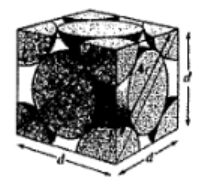
36. Silver crystallizes in a cubic closest packing (ccp) structure, which corresponds to a face-centered cubic (fcc) unit cell, as shown. The atomic radius of silver is r = 1.44 Å. Calculate the density of silver by completing the following steps. Report all calculated values to 3 significant figures.(1) There are effectively _ silver atoms in one unit cell.(2) The edge length of the unit cell, d, is _ Å.(3) The volume of the unit cell is _ cm³.(4) The total mass of silver in one unit cell is _ g.(5) The density of solid silver is _ g/cm³.
37. Pure water freezes at 0.00°C under 1 atm, and its molal freezing-point depression constant is Kƒ = -1.86°C kg mol⁻¹. A solution is prepared by dissolving 14.84 g of a non-electrolyte in 291.7 g of water. The freezing point of the solution is -0.276°C. Calculate the molar mass of the solute. Report your answer to 3 significant figures.
38. The complex ion [CoBr₄]²⁻ has a tetrahedral geometry. Answer the following questions.(1) How many 3d electrons are present in the cobalt center?(2) Draw the crystal-field splitting diagram for the 3d orbitals in a tetrahedral ligand field and indicate the electron configuration by placing the electrons in the appropriate orbitals.
 阿摩線上測驗
登入
阿摩線上測驗
登入