所屬科目:研究所、轉學考(插大)◆普通物理學
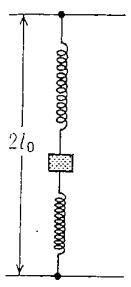
1. A block with mass m is vertically attached between two ideal springs with the force constant k and vertically oscillates (Fig. 1). What is the angular frequency?
(A) (B)(C) (D) (E)
2. Assume that the moon rotates around the earth with radius of 4 × 10⁸ m. What is the orbital period? The gravitational constant G = 6.67 × 10⁻¹¹ Nm²/kg², and the earth's mass ME = 5.97 × 10²⁴ kg. (A) 2.5 × 10⁴ s (B) 2.5 × 10⁵ s (C) 2.5 × 10⁶ s (D) 2.5 × 10⁷ s (E) 2.5 × 10⁸ s
3. A pendulum placed on the earth's surface has the period of 1 s. What is the period of this pendulum when placed on the moon surface? The radius and mass of the moon are 3/11 and 1/81 of the earth, respectively. (A) 0.1 s (B) 0.4 s (C) 1 s (D) 2.5 s (E) 10 s
4. An apple with mass 0.1 kg falls off from 10 m high to the ground. What is velocity of the apple when it hits the ground (friction is negligible)? The gravitational acceleration on the earth g = 9.8 m/s². (A) 14 m/s (B) 100 m/s (C) 0.1 m/s (D) 1 m/s (E) 10 m/s
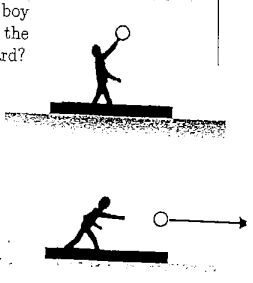
5. A boy stands on a board placed on a ice (frictionless). The mass of the boy including the board is 20 kg. When he throws a ball with mass of 1 kg to the right at the speed of 10 m/s (Fig. 2), what is the velocity of the boy and board?
(A) 10 m/s to the left (B) 10 m/s to the right (C) 0.5 m/s to the left (D) 0.5 m/s to the right (E) 0 m/s
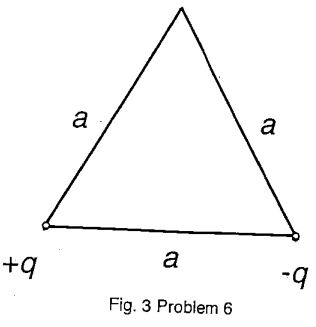
6. Two point charges q and −q are fixed at two corners of an equilateral triangle with side of a as shown in Fig. 3. What is the magnitude of electric field at the other corner?
(A) (B)(C)(D) (E) 0
7. A conducting sphere of radius a has a charge q. It is enclosed by a conducting shell of radius b with a charge −q as shown in Fig. 4. What is the potential difference V = φ(a) − φ(b)?
(A) (B) (C) 0 (D) (E)
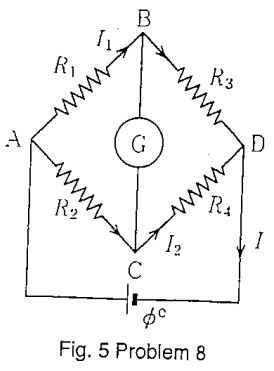
8. When there is no current through G in Fig. 5, what is the resistance R₄?
(A) (B) (C) (D)(E)
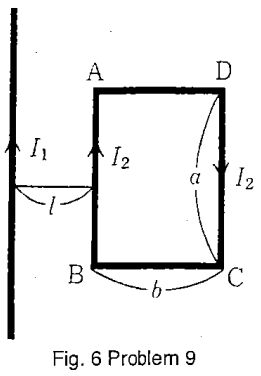
9. A very long wire and a loop are in the same plane and carrying current I₁ and I₂ as shown in Fig. 6. Which is the direction of the force on the loop.
(A) Parallel to I₁ (B) Perpendicular to I₁ and repulsive (C) Perpendicular to I₁ and attractive (D) Perpendicular to the plane (E) No force
10. A laser with power of 100 TW (= 100 × 10¹² W) is perfectly reflected by a mirror in the normal incidence frame. What is the force exerted on the mirror? (A) 3.3 × 10⁵ N (B) 6.7 × 10⁵ N (C) 3.3 × 10⁶ N (D) 6.7 × 10⁶ N (E) No force
11. One kilogram of liquid water at 100° C and 1 atm is vaporized to steam at the same temperature. The latent heat of vaporization of water is 2.3 × 10⁶ J/kg. The steam density at 1 atm is 0.6 kg/m³, and 1 atm is 1.0 × 10⁵ N/m². The volume of liquid water is negligible when compared with that of steam. What is the increase of internal energy? (A) 2.1 × 10⁶ J (B) 2.3 × 10⁶ J (C) 2.5 × 10⁶ J (D) 4.0 × 10⁶ J (E) 1.7 × 10⁵ J
12. A Carnot engine operates between 27°C and -23°C. What is the efficiency? (A) 100 % (B) 83 % (C) 54 % (D) 47 % (E) 17 %
13. Figure 7 shows a Carnot cycle in temperature (T) - entropy (S) diagram. Using TdS = dU + pdV, where U is internal energy, p is pressure, and V is volume, find the work done in each cycle in the T-S diagram.
(A) a (B) b (C) c (D) d (E) e
14. Consider a thermodynamic equilibrium of H₂ and O₂ gases. What is the ratio of the root mean square speeds ? (A) 1/16 (B) 16 (C) 1 (D) 1/4 (E) 4
15. The work function of sodium is 2.0 eV. A beam with a wavelength of 500 nm (= 500 × 10⁻⁹ m) illuminates the surface, what is the maximum kinetic energy of the photoelectrons? Here 1 eV = 1.6 × 10⁻¹⁹ J, the Plank's constant h = 6.6 × 10⁻³⁴ J·s, and the speed of light c = 3.0 × 10⁸ m/s. (A) 1.0 eV (B) 4.5 eV (C) 0.5 eV (D) 2.5 eV (E) 2.0 eV
16. X rays of wavelength 0.01 nm (= 0.01 × 10⁻⁹ m) are Compton scattered though an angle of 60°. What is the kinetic energy of the scattered electrons, which are initially at rest? Here 1 eV = 1.6 × 10⁻¹⁹ J, the Plank's constant h = 6.6 × 10⁻³⁴ J·s, the speed of light c = 3.0 × 10⁸ m/s, and the Compton wavelength λc = 2.42 × 10⁻¹² m. (A) 1.3 eV (B) 1.3 × 10 eV (C) 1.3 × 10² eV (D) 1.3 × 10³ eV (E) 1.3 × 10⁴ eV
17. What is the de Broglie wavelength of an electron with speed of 10⁶ m/s? The Plank's constant h = 6.6 × 10⁻³⁴ J·s, and the electron mass me = 9.1 × 10⁻³¹ kg. (A) 7.3 × 10⁻⁹ m (B) 7.3 × 10⁻¹⁰ m (C) 7.3 × 10⁻¹¹ m (D) 7.3 × 10⁻¹² m (E) 7.3 × 10⁻¹³ m
18. A rod has a proper length of 1 m in reference frame K'. In reference frame K the rod is half of its proper length. What is the velocity difference between K and K'? Here c is the speed of light. (A) c/4 (B) c/2 (C) 3c/4 (D) √3c/2 (E) c
19. A rocket A moves with speed of c/2 relative to the earth ( E ) reference frame. A rocket B moves with c/2 relative to A in the same direction. What is the velocity of B relative to E? Here c is the speed of light. (A) c (B) 4c/5 (C) 2c/3 (D) c/2 (E) 0
20. What is the speed of electron with kinetic energy of 1.5 MeV (without including the rest mass energy of m_ec² = 0.5 MeV)? Here c = 3.0 × 10⁸ m/s is the speed of light. (A) 1.5 × 10⁸ m/s (B) 2.0 × 10⁸ m/s (C) 2.5 × 10⁸ m/s (D) 2.8 × 10⁸ m/s (E) 3.0 × 10⁸ m/s
 阿摩線上測驗
登入
阿摩線上測驗
登入
 (A)
(A)  (B)
(B) (C)
(C) (D)
(D)  (E)
(E) 
 (A) 10 m/s to the left (B) 10 m/s to the right (C) 0.5 m/s to the left (D) 0.5 m/s to the right (E) 0 m/s
 (A)
(A) (B)
(B) (C)
(C) (D)
(D) (E) 0
(E) 0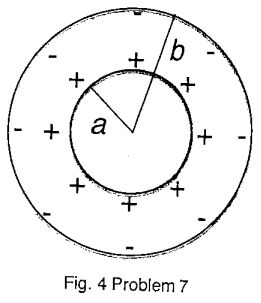 (A)
(A) 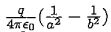 (B)
(B) (C) 0 (D)
  (E)
(E)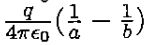
 (A)
(A)  (B)
(B)  (C)
(C)  (D)
(D) (E)
(E) 
 (A) Parallel to I₁ (B) Perpendicular to I₁ and repulsive (C) Perpendicular to I₁ and attractive (D) Perpendicular to the plane (E) No force
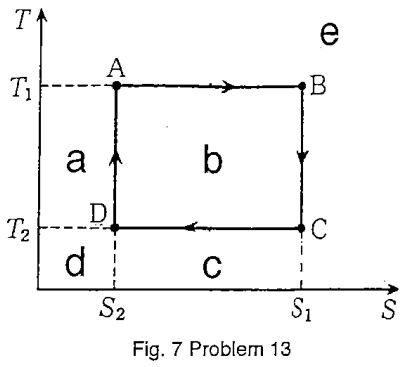 (A) a (B) b (C) c (D) d (E) e
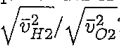 ? (A) 1/16 (B) 16 (C) 1 (D) 1/4 (E) 4