所屬科目:研究所、轉學考(插大)◆生化學
1. Which of the following statements is correct regarding acetyl-CoA carboxylase? (A) Acetyl-CoA carboxylase is an allosteric enzyme. (B) Acetyl-CoA carboxylase is regulated by hormones via changes in its phosphorylation state. (C) Acetyl-CoA carboxylase is the most important enzyme in the regulation of lipogenesis. (D) All of the above are correct
2. Which of the following statements is wrong regarding the regulation of acetyl-CoA carboxylase? (A) Citrate promotes the conversion of the enzyme from an inactive dimer to an active polymeric form (B) Long-chain acyl-CoA promotes inactivation of the enzyme by phosphorylation of the enzyme. (C) Long-chain acyl-CoA promotes the tricarboxylate transporter, which transports citrate out of mitochondria into the cytosol. (D) All of the above are correct
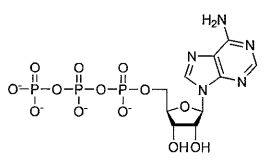
3. Which of the following nucleotide triphosphates is the structure above? (A) CTP (B) ATP (C) dATP (D) dCTP
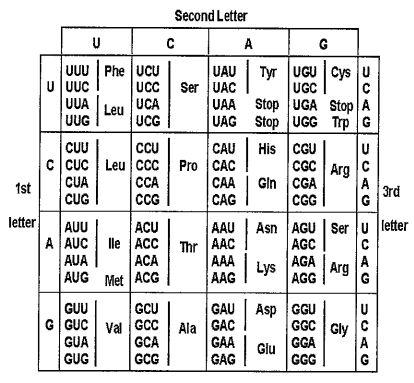
5. Based on the table above, which of the following DNA sequences corresponds to the potential coding region for this peptide? (表格請見試卷) (A) ATG CCT TAC GAT GTG CCT GAT TAT GCT (B) TAA CCC TAT GAT GTA CCC GAC TAC GCC (C) TAT CCA TAA GAC GTC CCA GAT TAT GCA (D) TAC CCG TAT GAC GTC CCG GAC TAC GCG
7. To further characterize the viral protein, a synthetic DNA probe with 18 nucleotides was used to screen cDNA libraries prepared from viral infected serum. According to the table above, which of the following peptides will minimize the number of DNA probes for the screening? (A) YPYDVP (B) PYDVPD (C) YDVPDY (D) DVPDYA
8. Which of the following descriptions of carnitine palmitoyltransferase-I is correct? (A) The enzyme is located in the inner mitochondrial membrane. (B) The enzyme transfers the long-chain acyl group from CoA to carnitine, forming acylcarnitine and releasing CoA. (C) The enzyme also binds acylcarnitine and transports it across the membrane in exchange for carnitine. (D) All of the above are correct.
9. Which of the following will be produced in platelets and, upon release, lead to vasoconstriction and platelet aggregation? (A) Thromboxanes (B) Prostacyclins (C) Leukotrienes (D) Lipoxins
10. Which below enzyme can use RNA as a template to synthesize DNA? (A) DNA polymerase (B) RNA polymerase II (C) Reverse transcriptase (D) Ligase (E) Helicase
11. Which RNA below transfers amino acid to a growing polypeptide chain during protein synthesis? (A) tRNA (B) mRNA (C) rRNA (D) siRNA (E) miRNA
12. Which amino acid of RNA polymerase's carboxy-terminal domain (CTD) can be phosphorylated by TFIIH? (A) Tyrosine (B) Threonine (C) Methionine (D) Serine (E) Histidine
13. Which trans-acting factor below binds to the TATA box? (A) Sp 1 (B) C/EBP (C) SRF (D) TBP (E) Fos
14. Which molecule below is the substrate of ribozymes? (A) DNA (B) RNA (C) Protein (D) Ribosome (E) Deoxyribose
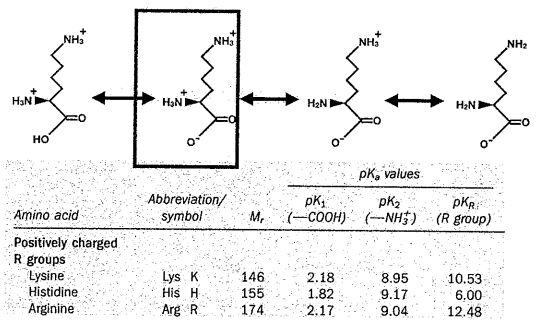
15. What is the pH value of the predominant lysine structure, in which the carboxylic acid is deprotonated to give a net charge of +1?
(A) pH 2 (B) pH 5 (C) pH 9 (D) pH 10
16. Aspartate carbamoyltransferase (ATCase) catalyzes the first step in the pyrimidine biosynthetic pathway, ultimately leading to the production of CTP. How does CTP regulate the activity of ATCase? (A) Positive homotropic effector (B) Negative heterotropic effector (C) Competitive enzyme inhibitor (D) Positive heterotropic effector
17. Ni-NTA Agarose is a nickel-charged affinity resin commonly used in protein purification. It has the highest affinity toward which type of amino acid side chain? (A) Hydrophobic side chains (B) Aromatic side chains (C) Negatively charged side chains (D) Histidine side chains
18. The Seahorse XFe Analyzer measures the oxygen consumption rate (OCR) as a key parameter in metabolic studies. What does the oxygen consumption rate (OCR) indicate in cellular metabolism? (A) The rate of mitochondrial oxidative phosphorylation (B) The rate of glucose uptake by glycolysis (C) The rate of ATP production exclusively from glycolysis (D) The rate of carbon dioxide production during cellular respiration
19. Which of the following statements is true regarding the composition of all sphingolipids? (A) All sphingolipids are made of ceramide, a sphingosine backbone with a fatty acid attached. (B) Sphingolipids contain a glycerol backbone and fatty acids. (C) Sphingolipids do not contain fatty acids. (D) All sphingolipids are made of phospholipids and cholesterol.
20. What is the primary source of glycerol in the human body? (A) Degradation of triglycerides in adipose tissue (B) Synthesis from glucose in the liver (C) Conversion from amino acids in muscle tissue (D) Absorption from dietary fat
21. Which of the following is correct about key differences between DNA synthesis and RNA synthesis? (A) DNA synthesis requires a primer, whereas RNA synthesis does not (B) RNA synthesis is more accurate than DNA synthesis (C) RNA synthesis occurs only during cell division, whereas DNA synthesis is continuous (D) During DNA replication, only a portion of the genome is synthesized.
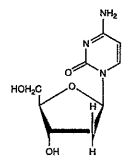
22. What is the name of this compound? (A) Cytosine (B) Cytidine (C) Deoxycytidine (D) Deoxycytidylate
23. Which group of amino acids is primarily responsible for absorbance in spectrophotometry? (A) Non-polar amino acids (B) Polar amino acids (C) Aromatic amino acids (D) Positively charged amino acids (E) Negatively charged amino acids
24. In adipose tissue, what is the primary source of glycerol 3-phosphate for triacylglycerol synthesis? (A) Direct phosphorylation of glycerol by glycerol kinase (B) Reduction of dihydroxyacetone phosphate (DHAP), which originates from glycolysis (C) Degradation of phospholipids (D) Conversion of glucose to glycerol 3-phosphate via the pentose phosphate pathway
25. Which of the following is NOT a common mechanism of signal transduction across the cell membrane? (A) Ion channel-linked receptors (B) G-protein coupled receptors (C) Enzyme-linked receptors (D) Nuclear receptors
26. Which of the following statements is NOT true about phosphorylation? (A) Phosphorylation is a common post-translational modification. (B) Phosphorylation always leads to a change in protein conformation and a decrease in protein charge. (C) Phosphorylation typically involves the addition of a phosphate group to a serine, threonine, or tyrosine residue. (D) Phosphorylation always leads to protein activation.
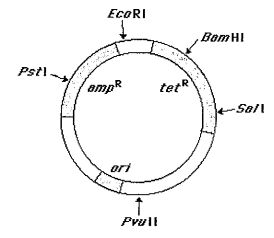
30. Match each feature of the plasmid pBR322 (at left) with one appropriate description presented (at right) (see illustration of pBR322 below). Descriptions may be used more than once. (5%)
_____ ampR sequence
_____ori sequence
_____tetR
_____BamHI sequence
_____Pstl sequence
(A) permits selection of bacteria containing the plasmid(B) a sequence required for packaging recombinant plasmids into bacteriophage(C) origin of replicatio(D) cleavage of the plasmid here does not affect antibiotic sequence resistance genes(E)insertion of foreign DNA here permits identication of bacteria containing recombinant plasmids
4. Continuing the question above, please draw the structure of dideoxy form of the structure above.
A peptide sequence, "YPYDVPDYA," which is derved fom a viral protein and plays a role in bing the virus to cell rectorerrrr to initiate infection, has recently been identified. Please answer the following questions.
6. What is the complementary sequence of the sequence above?
27. Describe the allosteric regulation of hemoglobin. How does this regulation facilitate oxygen delivery to tissues?
28. Name two enzymes and explain how their names reflect their function or substrate.
29. Draw a schematic diagram illustrating the signal transduction pathway of a G-protein coupled receptor (GPCR).
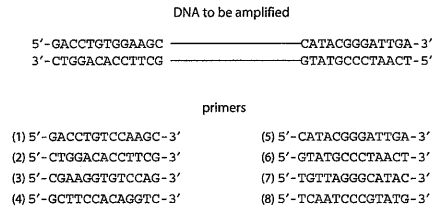
31. You want to amplify the DNA between the two stretches of sequences shown in Figure below. Of the listed primers choose the pair that will allow you to amplify the DNA by PCR.
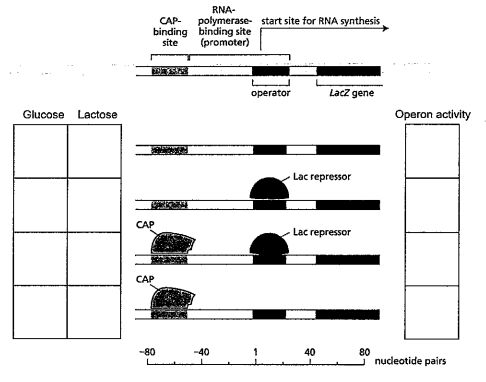
32. In Figure below, the bacterial activator protein CAP and the Lac repressor have been placed in the four possible combinations on their binding sites in the promoter for the Lac operon. Each combination of gene regulatory proteins corresponds to a particular mixture of glucose and lactose. For each of the four combinations, indicate on the left-hand side of the figure which sugars (glucose or lactose) must be present (or absent) and, on the right-hand side, whether the operon is expected to be turned ON or OFF.
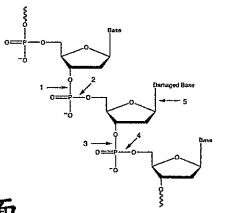
33. Using the figure on right, what is the first bond broken in the base excision repair process?
34. The E. coli chromosome contains 4,639,221 base pairs. How long would it take to replicate the E. coli chromosome at 37 °C if two replication forks proceed from the origin? Assume replication occurs at a rate of 1,000 base pairs per second. Under some conditions E. coli cells can divide every 20 min. How might this be possible?
 阿摩線上測驗
登入
 (A) Citrate promotes the conversion of the enzyme from an inactive dimer to an active polymeric form (B) Long-chain acyl-CoA promotes inactivation of the enzyme by phosphorylation of the enzyme. (C) Long-chain acyl-CoA promotes the tricarboxylate transporter, which transports citrate out of mitochondria into the cytosol. (D) All of the above are correct
 (A) Non-polar amino acids (B) Polar amino acids (C) Aromatic amino acids (D) Positively charged amino acids (E) Negatively charged amino acids
 (A) permits selection of bacteria containing the plasmid(B) a sequence required for packaging recombinant plasmids into bacteriophage(C) origin of replicatio(D) cleavage of the plasmid here does not affect antibiotic sequence resistance genes(E)insertion of foreign DNA here permits identication of bacteria containing recombinant plasmids