所屬科目:研究所、轉學考(插大)◆普通物理學
1. Consider the situation shown in the figure, where a baseball player slides to a stop on level ground. Using energy considerations, calculate the distance the 65.0-kg baseball player slides, given that his initial speed is 6.00 m/s and the force of friction against him is a constant 450 N. (A)0.6 m (B)1.6 m (C)2.6 m (D)3.6 m (E)4.6 m
2. The Moon orbits Earth each 27.3 days and it has an average distance of 3.84×10⁸ m from the center of Earth. Calculate the period of an artificial satellite orbiting at an average altitude of 1500 km above Earth's surface. The radius of Earth is 6380 km. (A) 0.57 hr (B) 1.9 hr (C) 5.7 hr (D) 19 hr (E) 57 hr
3. What is the final speed of the roller coaster shown in the figure if it starts from rest at the top of the 20.0 m hill and work done by frictional forces is negligible? The gravitational acceleration on Earth's surface is 9.8 m s-2. (A)2.4 m/s (B) 4.9 m/s (C) 9.8 m/s (D) 19.8 m/s (E) 29.4 m/s
4. The escape velocity (minimum velocity to escape the Earth's gravitational potential) for a 100-kg object on Earth is about 11 km/s. What is the escape velocity of a 50-kg object on the surface of Earth? (A) 11 km/s (B) 22 km/s (C) 5.5 km/s (D) 44 km/s (E) 2.75 km/s
5. At what temperature would helium atoms have an rms speed enough to escape the Earth's gravitational potential? The proton mass is kg. (A) 200 K (B) 600 K (C) 2×10³ K (D) 6×10³ K (E) 2×10⁴ K
6. Suppose an ice skater is soing at 0.8 revolutions (rev) per second with her arns extended. She has a moment of ineria of 2.34 kg • m2 with her arms extended and of 0.363 kg • m2 with her a close to her body (appropriate for a 60-kg skater). What is her angular velocity in revolutions per second after she pulls in her arms?(A) 2.2 rev/s (B) 3.2 rev/s (C) 4.2 rev/s (D) 5.2 rev/s (E) 6.2 rev/s
7. A block of mass oscillates at the end of a horizontal spring on a frionless surface. Al maximum extension,an identical block drops onto the top of the first block and sticks to it. How does the new period Tnew compare to the original period,T0? (A) Tnew = 0.5 T0 (B) Tnew = T0 (C) Tnew = √2 T0 (D) Tnew = 2 T0 (E) Tnew = 3 T0
8. What is the ratio of the ectrostatic force between an electron and proton separated by m to to the gravitational force between them? Their separation is the average separation in a bydrogen atom. The electron has a mass of kg and a charge of . The gravional constant is G=N and the Coulomb constant is k = 8.99x10⁹ N . (A) (B) (C) 2.3×10⁹ (D) 2.3×10¹⁹ (E) 2.3×10³⁹
9. For a uniform-density, spherical object with a mass M and a radius R. what is its gravional potential energy?(A) -5GM²/3R (B) -GM²/5R (C) -3GM²/4R (D) -2GM²/3R (E) -3GM²/5R
10. Calculate the kinetic energy of a photon with a wavelength of 500 nm and the kinetic energy of an electron that has the same momentum as the photon . What is the ratio of ? The Planck cont is is h =. (A) 4.1×10⁻⁵ (B) 4.1×10⁻² (C) 4.1×10² (D) 4.1×10³ (E) 4.1×10⁵
11. How does the spectrum of a molecule differ from the spectrum of an atom? (A) A molecule does not have spectral lines due to electrons changing energy levels. (B) A molecule has additional spectral lines due to changes in its rotational and vibrational energies. (C) Molecules only have spectral lines at ultraviolet wavelengths. (D) Most atoms only have spectral lines at infrared wavelengths. (E) An atom has a wider range of spectral lines than molecules.
12. What is the kinetic energy of an electron moving with a speed of v = 0.85c? (A) 0.511 MeV (B) 0.370 MeV (C) 0.464 MeV (D) 0.185 MeV (E) 0.821 MeV
13. As a solid disk rolls over the top of a hill on a track, its speed is 80 cm/s. If friction is negligible, how fast is the disk moving when it is 18 cm below the top? (A) 5.2 m/s (B) 3.5 m/s (C) 2.4 m/s (D) 1.7 m/s (E) 0.2 m/s
14. A point explosion with thermal energy E occurs at time t = 0, driving a spherical shock wave into a uniform medium of density p. From dimensional analysis, the radius of the shock R should have a time dependence of (A)(B)(C)(D) R ∝ t (E)
15. Consider a surface water wave with a wavelength λ (and thus a wavenumber k = 2π/λ) propagating in the ocean with a depth H. The gravitational acceleration is g. In the case of λ<<H, the wave velocity is (A) (B)(C)(D)(E)
16. A copper can of negligible heat capacity contains 1.0 kg of water just above the freezing point. A similar can contains 1.0 kg of water just below the boiling point. The two cans are brought into thermal contact. What is the change in entropy of the system? The specific heat capacity of water is 4180 J . (A) +404 J/K (B) +202 J/K (C) +101 J/K (D) The entropy is unchanged (E) -202 J/K
17. What is the work done by the magnetic force on a straight wire 10 cm long carrying a current of 12 A that moves by 2 m in a magnetic field of 2 T perpendicular to the wire? (A) 2.4 J (B) 1.2 J (C) 7.2 J (D) 4.8 J (E) 0
18. Find the center of mass of a right circular cone (as shown in the figure) of height h, radius r, and constant density. (A) h/4 (B) h/3 (C) 2h/3 (D) h/5 (E) 2h/5
 阿摩線上測驗
登入
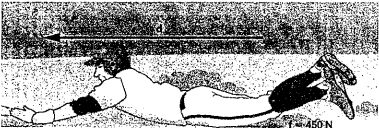 (A)0.6 m (B)1.6 m (C)2.6 m (D)3.6 m (E)4.6 m
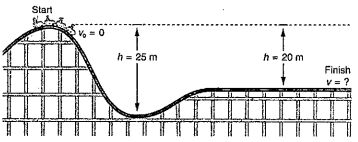 (A)2.4 m/s (B) 4.9 m/s (C) 9.8 m/s (D) 19.8 m/s (E) 29.4 m/s
 kg. (A) 200 K (B) 600 K (C) 2×10³ K (D) 6×10³ K (E) 2×10⁴ K
 m to to the gravitational force between them? Their separation is the average separation in a bydrogen atom. The electron has a mass of
 kg and a charge of
 . The gravional constant is G=
 N
 and the Coulomb constant is k = 8.99x10⁹ N
 . (A)
 (B)
 (C) 2.3×10⁹ (D) 2.3×10¹⁹ (E) 2.3×10³⁹
 and the kinetic energy of an electron that has the same momentum as the photon
 . What is the ratio of
 ? The Planck cont is is h =
 . (A) 4.1×10⁻⁵ (B) 4.1×10⁻² (C) 4.1×10² (D) 4.1×10³ (E) 4.1×10⁵
 (B)
 (C)
 (D) R ∝ t (E)

 (B)
 (C)
 (D)
 (E)

 . (A) +404 J/K (B) +202 J/K (C) +101 J/K (D) The entropy is unchanged (E) -202 J/K
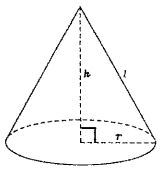 (A) h/4 (B) h/3 (C) 2h/3 (D) h/5 (E) 2h/5