阿摩線上測驗
登入
首頁
>
駕照◆汽車法規(英文)
> 115年 - 汽車駕照筆試_英文 601-650(2026/05 更新)#145223
115年 - 汽車駕照筆試_英文 601-650(2026/05 更新)#145223
科目:
駕照◆汽車法規(英文) |
年份:
115年 |
選擇題數:
50 |
申論題數:
0
試卷資訊
所屬科目:
駕照◆汽車法規(英文)
選擇題 (50)
601.Under which circumstances may a motor vehicle driver sound the horn? (A) When approaching a sharpcurve. (B) When intending to overtake the vehicle ahead in the same lane on a suburban road. (C) Both ofthe above are permitted.
602.When a car experiences a tire skid while navigating a curve, what is the safest course of action? (A)Immediately press the brakes to slow down. (B) Quickly turn the steering wheel to correct the direction.(C) Release the accelerator and avoid sudden acceleration or sudden braking.
603.When a driver sees a 'Junction' warning sign ahead, how should they respond? (A) There is anintersection ahead; slow down and watch for vehicles that may merge from the side. (B) The road aheadis about to end; prepare to make a U-turn or take a detour. (C) The road ahead splits into two lanes;choose the inner lane and accelerate away from the diverging section.
604.When a car approaches a multi-lane roundabout, which of the following statements about right-of-way iscorrect? (A) Vehicles in the inner lane should be given priority. (B) Vehicles in the outer lane should begiven priority. (C) Vehicles coming from the wider road or the road with heavier traffic have priority toenter the roundabout.
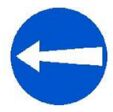
605.What does this sign represent? (A) Mandatory direction of travel. (B) One-way road. (C) Park on the leftside.
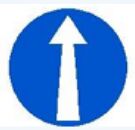
606.What does this sign represent? (A) Mandatory direction of travel. (B) One-way road. (C) For motorvehicles only.
607.When reaching an intersection with a dedicated left-turn signal, what should the driver do when the leftturn signal lights up? (A) Immediately accelerate through the intersection to avoid disrupting trafficbehind. (B) Turn left as indicated by the signal and pay attention to other vehicles and pedestrians. (C)Stop first to observe, and turn left slowly only after confirming no vehicles are present.
608.On a road with a dividing island separating fast and slow lanes, which of the following rules regardingturning is correct for vehicles traveling in the slow lane? (A) Under safe conditions, vehicles in the slowlane may turn left at any time. (B) Vehicles in the slow lane may not turn left directly. (C) Vehicles in theslow lane may turn left directly only when there are no oncoming vehicles.
609.A car is waiting to turn left at an intersection. When the signal changes to a circular green light, howshould the driver proceed? (A) To maintain traffic flow, turn on the turn signal and make the left turnimmediately. (B) Must wait until there are no oncoming vehicles going straight, and may only turn left afterconfirming it is safe; preemptive passage is not allowed. (C) No need to consider oncoming straight-goingvehicles; as long as you are within the center point of the intersection, you may turn left with priority.
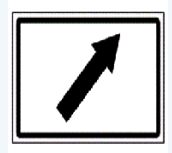
610.What is the meaning of the pictorial sign? (A) Keep to the left. (B) Right turn direction. (C) Left turnNo. Ans Questiondirection.No. Ans Question
611.When turning right at an intersection, you should first: (A) Display a turn signal or hand signal. (B) Changelanes. (C) Turn.
612.When turning right: (A) First display the right turn signal at the front and rear. (B) First display the left turnsignal. (C) Extend the right arm horizontally.
613.On road sections with curve, slope, or narrow road signs, you should: (A) Speed up to avoid congestion.(B) Honk at the vehicle ahead to speed up. (C) Slow down and be prepared to stop at any time.
614.A vehicle in the inner lane intending to turn left at an intersection should: (A) Display the turn signal 30meters before the intersection and turn left at the center of the intersection. (B) Turn left immediatelyupon reaching the intersection. (C) Display the right turn signal and turn left.
615.On road sections with curve, slope, narrow bridge, or tunnel signs, or at railway level crossings: (A) Uturns are allowed. (B) U-turns are allowed at speeds below 5 km/h. (C) U-turns are not allowed.
616.Before making a U-turn: (A) Stop and display the left turn signal or hand signal, check for traffic in bothdirections, watch for pedestrians, then make the U-turn. (B) Glance left and right, and turn when clear. (C)Honk 3 times, then make the U-turn.
617.Which of the following is incorrect regarding left turns at an intersection? (A) You may only turn left whenthe left-turn signal is on. (B) You may turn left after straight-going vehicles have passed. (C) You mayrush to turn left as soon as the green light comes on.
618.A driver on a road with a traffic island separating fast and slow lanes, while in the fast lane: (A) May turnright. (B) Must not turn right. (C) No specific regulation.
619.On roads with three or more lanes in the same direction, large vehicles must not drive in which lane,except when preparing to turn left? (A) The inner lane. (B) The middle lane. (C) The outer lane.
620.When opposing vehicles turn left and right into a road with two or more lanes: (A) Left-turning vehiclesenter the outer lane; right-turning vehicles enter the inner lane. (B) Right-turning vehicles enter the outerlane; left-turning vehicles enter the inner lane. (C) Vehicles may drive in any lane.
621.The faster a vehicle travels around a curve, the centrifugal force produced is: (A) Greater. (B) Smaller. (C)Unchanged.
622.When turning or changing lanes, drivers should develop the habit of turning their head to look left andright because: (A) To check for oncoming vehicles. (B) To watch for blind spots not visible in the rearviewmirror. (C) To avoid glare from the windshield.▸ Turning (Left / Right Turns, U-turns)No. Ans Question
623.You are stopped at an intersection and a large vehicle is stopped to your front-left, preparing to turn right.Which of the following is most reasonable? (A) Turning vehicles must yield to straight-going vehicles, soyou should pass through as quickly as possible. (B) If you can see the large vehicle's side mirrors, itmeans the other driver can definitely see you. (C) You should avoid approaching its right side and theinner turning zone, yield to the large vehicle to turn right first, and avoid getting caught in its rear wheeloffset and blind spots.
624.Regarding the sensing limitations of Adaptive Cruise Control (ACC), which of the following objects ismost likely to cause the system to misjudge and lead to an accident? (A) A large vehicle traveling steadilyahead in the lane at normal speed. (B) A construction buffer vehicle completely stationary in a work zone.(C) A regular heavy motorcycle changing lanes at a steady speed in an adjacent lane.
625.A large vehicle is traveling inside a tunnel where the vehicle ahead is moving slowly and there are noobvious prohibition signs. Which of the following is correct? (A) Should maintain lane position and keep asafe following distance. (B) May change lanes and overtake at any time. (C) May briefly accelerate toNo. Ans Questionovertake, then return to the original lane.
626.When a large vehicle makes a right turn, what is the most correct operation to avoid accidents caused bythe inner wheel difference? (A) When turning right, the vehicle should activate the turn signal 30 metersbefore the intersection, move into the outer lane, right-turn lane, or slow lane, and then make the rightturn after reaching the intersection. (B) Hug the right side and turn directly to shorten the distance. (C)Accelerate through the intersection to avoid obstructing traffic.
627.When a large vehicle loaded with cargo passes through a tunnel and encounters traffic congestion, whichof the following is most compliant with regulations? (A) You may follow closely behind the vehicle aheadto prevent other vehicles from cutting in. (B) Maintain a safe following distance, ensure the cargo issecure, and avoid changing lanes arbitrarily. (C) You may change lanes as appropriate to improve trafficefficiency.
628.While driving on a freeway and encountering a vehicle slowing down ahead, how should you respond?(A) Apply emergency brakes immediately. (B) Maintain a safe following distance and gradually reducespeed. (C) Change lanes and overtake quickly.
629.When intending to change lanes from the outer lane to the middle lane on a multi-lane road, whichregulation should the driver follow? (A) First activate the turn signal or use a hand gesture in the directionof the intended lane change. (B) You may change lanes directly if the distance is sufficient. (C) Sound thehorn as a warning and then change lanes.
630.Regarding overtaking and yielding by motor vehicle drivers, which of the following is incorrect? (A)Overtaking is prohibited on curves, steep slopes, narrow bridges, tunnels, and road constructionsections. (B) When overtaking the vehicle ahead, continuously honk the horn and flash the lights to forcethe vehicle ahead to yield. (C) Drivers should yield to driving school vehicles, vehicles exclusively foryoung children, specially-made vehicles for persons with disabilities, and school buses.
631.A large truck is traveling in the slow lane on a downhill slope in rainy weather with poor visibility. Thecargo has a high center of gravity and slightly extends beyond the rear of the vehicle. Ahead is a narrowtunnel exit and an intersection. Nearby pedestrians and motorcyclists are approaching. As the driver,what is the most appropriate course of action? (A) Reduce speed to below the minimum speed limit of theslow lane, maintain lane position, watch for off-tracking, blind spots, give priority to pedestrians, ensurecargo is secure, and be ready to stop at any time. (B) Maintain the slow lane speed limit and only payattention to traffic from behind. (C) Sound the horn to alert surroundings, then pass through thehazardous area quickly to maintain smooth traffic flow.
632.When a driver is following a large vehicle and approaching an upcoming intersection, the traffic signal isabout to turn red. What is the most appropriate action? (A) Immediately overtake the vehicle ahead andaccelerate through to avoid stopping. (B) Reduce speed and maintain a safe following distance from thelarge vehicle ahead. (C) Follow the large vehicle closely to prevent other vehicles from cutting in.
633.When driving on a freeway and encountering dense fog, heavy smoke, strong winds, heavy rain,nighttime driving, or other special conditions, what safe following distance should be maintained from thevehicle ahead? (A) Maintain the normal safe following distance. (B) Small vehicles adopt the safefollowing distance of large vehicles; the safe following distance for large vehicles remains unchanged. (C)The safe following distance should be increased accordingly and maintained at a distance within whichthe vehicle can be brought to a complete stop.
634.Under normal weather conditions, when a vehicle is traveling on a freeway or expressway at a speed of90 kilometers per hour, the safe following distance between the vehicle and the one ahead is: (A) 45meters for large vehicles, 70 meters for small vehicles. (B) 70 meters for large vehicles, 45 meters forsmall vehicles. (C) 70 meters for both large and small vehicles.
635.Our vehicle has not yet entered the intersection, but an oncoming large vehicle has already entered theintersection and is making a turn. What is the most appropriate action? (A) Turning vehicles must yield tostraight-going vehicles, so the large vehicle should give way to us first. (B) Stop in advance at the stopline and allow it to pass first. (C) Honk the horn repeatedly to pressure the large vehicle to yield.
636.When a small car is following a large vehicle, how should the driver ensure safety? (A) Drive close behindto prepare for overtaking. (B) Maintain a safe following distance and pay attention to the vehicle ahead.(C) Accelerate suddenly to overtake.
637.When a large vehicle is traveling on a narrow road and an oncoming vehicle is a small car, what is themost appropriate action? (A) The large vehicle has the right of way. (B) Slow down and yield as theNo. Ans Questionsituation requires. (C) Honk to demand the other vehicle to give way.
638.How should a driver handle passing on a narrow road when meeting oncoming traffic? (A) Slow downand yield. (B) Speed up and pass through. (C) Honk to demand the other driver to give way.
639.When a large vehicle arrives at an unsignalized intersection and an oncoming vehicle has alreadyentered the right-of-way zone, what is the most correct action? (A) The larger vehicle may proceed firstdue to its size. (B) Slow down and let the other vehicle go first. (C) No need to slow down, just watch therear.
640.Which of the following regulations regarding the use of lights is incorrect? (A) When driving through atunnel, since the tunnel lighting is clear and visibility is good, you may choose not to turn on headlights tosave electricity. (B) Fog lights shall not be used except in rain, fog, or snow. (C) When driving throughmountain areas or special road sections announced by highway authorities or police agencies, tunnels,or vehicular underpasses, lights shall be used as indicated by signs.
641.A large vehicle loaded with sand and gravel is traveling in the slow lane of a road with a lane dividing line,and passes through an unsignalized intersection on a rough road surface. Which of the following bestcomplies with regulations? (A) Cargo must be properly covered and secured, and the driver must followthe slow lane speed limit, reduce speed, and be ready to stop at any time. (B) As long as the speed limitis not exceeded, cargo shifting is normal and requires no action. (C) Only the slow lane speed limit of 40km/h needs to be met; there is no special requirement to cover the cargo.
642.When a vehicle breaks down and cannot be driven, it should be moved to a location that does notobstruct traffic. Regarding the handling of breakdown warning signs before or after the vehicle is moved,which of the following is incorrect? (A) On roads with a speed limit of 40 km/h or below, the sign shouldbe placed on the road surface 100 meters behind the vehicle; placement at an appropriate position infront of the vehicle may be set as needed. (B) On roads with a speed limit exceeding 40 km/h, the signshould be placed on the road surface between 30 and 100 meters behind the vehicle; placement at anappropriate position in front of the vehicle may be set as needed. (C) On congested road sections, thesign should be hung on the rear of the vehicle; placement at an appropriate position in front of the vehiclemay be set as needed.
643.To avoid accidents with large vehicles, which of the following is the correct concept? (A) Drive as close tolarge vehicles as possible. (B) Avoid entering blind spots and maintain a safe following distance. (C) Passquickly from the right side.
644.When a car driver stops at an intersection waiting for a signal and is positioned at the front-right of a largevehicle, what is the most likely risk? (A) The large vehicle has a clear line of sight and can clearly identifythe small car to its front-right, allowing both to pass safely. (B) The small car enters the inner wheeldifference zone on the side of the large vehicle, making it difficult for the large vehicle driver to notice,creating a risk of being caught and run over by the rear wheels. (C) The large vehicle starts slowly, so thesmall car can take the opportunity to pass through the intersection first without any danger.
645.Regarding a large vehicle parked on the roadside at night when visibility is poor, or when on a road atnight with no lighting equipment or insufficient illumination, which of the following handling methods iscorrect? (A) Only turning on the parking lights is sufficient. (B) No lighting indication is needed. (C) Parkinglights or reflective markers should be displayed.
646.When a large vehicle is traveling on a highway and follows the vehicle ahead too closely, what is themost likely danger? (A) It improves driving efficiency. (B) It increases vehicle stability. (C) The shortenedreaction time leads to a rear-end collision.
647.Which of the following regulations regarding temporarily stopping a vehicle on the roadside is incorrect?(A) At places where temporary stopping is prohibited, you may stop briefly as long as you do not obstructother vehicles or pedestrians. (B) Parking is prohibited at the entrances and exits of airports, stations,docks, schools, entertainment venues, exhibition halls, stadiums, markets, or other public places, and infront of fire hydrants. (C) When parking, the vehicle shall be parked closely along the edge of the road inthe direction of traffic flow, with the outer edges of the front and rear tires no more than 60 cm from thecurb or road edge.
648.If a small vehicle suddenly cuts in front of a large vehicle and brakes sharply, how should this behaviorbe classified? (A) It is a legal driving behavior in an emergency situation and does not constitute aviolation. (B) It is a traffic violation and is likely to cause a traffic accident. (C) Small vehicles have theright of way and only need to be mindful of the following distance.No. Ans Question
649.Which of the following correctly describes the meaning of a "blind spot" on a large vehicle? (A) The areathat the driver can fully see through the rear-view mirrors. (B) The area that the driver cannot observeeither directly or indirectly. (C) Only the area behind the vehicle that cannot be seen.
650.Regarding the blind spots of large vehicles, which of the following is an incorrect concept? (A) Blind spotsmay exist on the sides of the vehicle. (B) As long as you can see the driver, you can be sure the drivercan see you. (C) The extent of blind spots may vary depending on the type of vehicle.No. Ans Question
申論題 (0)
相關試卷
115年 - 汽車駕照筆試_英文 1051-1090(2026/05 更新)#145232
115年 · #145232
115年 - 汽車駕照筆試_英文 1001-1050(2026/05 更新)#145231
115年 · #145231
115年 - 汽車駕照筆試_英文 951-1000(2026/05 更新)#145230
115年 · #145230
115年 - 汽車駕照筆試_英文 901-950(2026/05 更新)#145229
115年 · #145229
115年 - 汽車駕照筆試_英文 851-900(2026/05 更新)#145228
115年 · #145228
115年 - 汽車駕照筆試_英文 801-850(2026/05 更新)#145227
115年 · #145227
115年 - 汽車駕照筆試_英文 751-800(2026/05 更新)#145226
115年 · #145226
115年 - 汽車駕照筆試_英文 701-750(2026/05 更新)#145225
115年 · #145225
115年 - 汽車駕照筆試_英文 651-700(2026/05 更新)#145224
115年 · #145224
115年 - 汽車駕照筆試_英文 551-600(2026/05 更新)#145222
115年 · #145222