阿摩線上測驗
登入
首頁
>
駕照◆汽車法規(英文)
> 115年 - 汽車駕照筆試_英文 751-800(2026/05 更新)#145226
115年 - 汽車駕照筆試_英文 751-800(2026/05 更新)#145226
科目:
駕照◆汽車法規(英文) |
年份:
115年 |
選擇題數:
50 |
申論題數:
0
試卷資訊
所屬科目:
駕照◆汽車法規(英文)
選擇題 (50)
751.Regarding the safe following distance between the front and rear vehicles for a passenger car driving ona freeway or expressway, which of the following is correct under normal weather conditions? (A) Thevehicle's speed in km/h divided by 2 (unit: metres). (B) The vehicle's speed in km/h minus 20 (unit:metres). (C) The safe distance is up to the driver's own judgement; there is no regulation.
752.A driver travels along a road section where a median island or obstacle is set in the centre of the roadand sees a 'Keep Right' compliance sign. Which of the following statements is correct? (A) Vehicles mustpass to the right side of the obstacle or median island and must not enter the left side. (B) The signmerely reminds drivers of the customary right-hand traffic practice in our country; drivers may choose topass on either the left or right according to road conditions. (C) The sign indicates that the road ahead isone-way, and all vehicles may only travel in the same direction.
753.When driving on a road that has a minimum speed limit sign, which of the following is correct? (A) Adriver who drives below the minimum speed limit shall be fined. (B) Driving below the speed limit isacceptable as long as it does not affect traffic safety. (C) Driving at low speed is safer and does notconstitute a violation.
754.A 'unidirectional no-overtaking line' consisting of a solid yellow line and a dashed yellow line drawn sideby side in the centre of the road — regarding the traffic regulations for vehicles on both sides, which ofthe following is correct? (A) Vehicles on both the solid-line side and the dashed-line side are prohibitedfrom crossing over to overtake, with the same effect as a double solid yellow line. (B) Vehicles on thesolid-line side are prohibited from crossing over to overtake; vehicles on the dashed-line side may crossover to overtake when it is safe to do so. (C) Vehicles on the dashed-line side are prohibited fromcrossing over to overtake; vehicles on the solid-line side may cross over to overtake when it is safe to doso.
755.Both 'Road Hump' and 'Rough Road' are warning signs for road surface conditions. Which of thefollowing correctly describes the difference between the two? (A) 'Road Hump' indicates a localized,prominent raised surface ahead; 'Rough Road' indicates a continuously uneven surface ahead. Driversshould slow down for both. (B) Both signs describe the same road condition; only the speed limit of theposted section differs. Drivers may maintain their current speed. (C) 'Road Hump' indicates acontinuously uneven surface ahead; 'Rough Road' indicates a localized raised surface. Drivers shouldaccelerate quickly through both to reduce the sensation of bumping.No. Ans Question
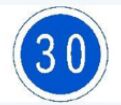
756.What does this sign represent? (A) Minimum speed limit. (B) Maximum speed limit. (C) Motorcycle speedlimit.
757.What does it mean when headlight beams shine farther at night? (A) There is an uphill section ahead. (B)There is a downhill section ahead. (C) The road surface ahead is flat.
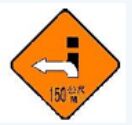
758.What is this sign? (A) Road closed. (B) Vehicle detour. (C) No motor vehicles entry.
759.When a motor vehicle reaches a controlled road, what are the traffic rules for passage? (A) Remove thecontrol facilities yourself and pass freely. (B) Travel in accordance with the traffic control regulationsindicated by official notices or signs. (C) You may pass whenever no control personnel are present.
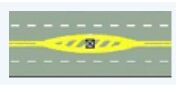
760. What is the meaning of the yellow road marking shown in the figure? (A) Approach obstacle line. (B) Stopline. (C) Lane line.
761.Which of the following is correct regarding the effects of rapid vehicle acceleration on the vehicle and fuelconsumption? (A) It can improve fuel efficiency and make the vehicle more fuel-efficient. (B) It increasesfuel consumption and reduces driving efficiency. (C) It has no significant effect on fuel consumption andonly affects driving speed.
762.When a vehicle is traveling on a two-way two-lane road marked with directional restriction lines: (A) Whenthere is no oncoming traffic, the vehicle may enter the oncoming lane to overtake. (B) It is prohibited toenter the oncoming lane. (C) The vehicle may travel freely in any lane.
763.The white double solid line 'no lane change line' drawn between lanes in the same direction is mostcommonly installed on which of the following road sections? (A) Near intersections, ramp entrances andexits, or accident-prone sections, to prevent vehicles from changing lanes arbitrarily and affecting trafficsafety. (B) Straight sections in suburban areas with low traffic volume, reminding drivers to stay in thesame lane. (C) All roads with a central median island, used to separate opposing traffic directions.
764.For large heavy motorcycles with a total engine displacement of 550cc or above, when traveling onfreeways or expressways: (A) As long as a safe following distance is maintained, they may ride side byside or overtake within the same lane. (B) They must travel in sequence within the same lane as required,and are not permitted to ride side by side or overtake within the same lane. (C) When traffic volume islow, they may ride side by side or overtake within the same lane.
765.A driver is traveling on a road section marked with a 'No Passing' sign. Which of the following actions stillconstitutes a violation? (A) Passing a slower vehicle ahead by using the same-direction lane withoutcrossing the road centerline. (B) A vehicle ahead has broken down and stopped on the roadside; thedriver passes it by going around its left side. (C) Passing the vehicle ahead from the left lane in the samedirection at a speed higher than the vehicle in front, then immediately returning to the original lane.
766.Regarding a driver's use of 'driving assistance display devices' while operating a vehicle on the road,which of the following statements is correct? (A) As long as it is factory-installed equipment, the drivermay operate the driving assistance display device freely while the vehicle is in motion. (B) Settings for thedriving assistance display device should be completed before departure; operating the device while thevehicle is in motion is prohibited. (C) The driving assistance display device may be continuously watchedor operated while the vehicle is in motion as a substitute for paying attention to road conditions.
767.Regarding the description of the difference between white arrow 'directional guide lines' painted on theroad surface before an intersection and 'lane-use arrow markings' painted within a lane, which of thefollowing is correct? (A) 'Directional guide lines' are mandatory; vehicles must travel in the direction of thearrow and may not change to another lane. (B) 'Directional guide lines' serve to pre-announce thedirection to be taken at the upcoming intersection, guiding drivers to move into the appropriate lane inadvance; 'lane-use arrow markings' strictly restrict that lane to vehicles traveling in the arrow directiononly. (C) Both serve the same function; they differ only in arrow size and placement location.No. Ans Question
768.Regarding the regulations on seatbelt usage by passengers inside a large bus traveling on a highway orexpressway, which of the following is correct? (A) Only the driver and front-seat passengers are requiredto wear seatbelts. (B) The driver and all passengers aged 4 and above must wear seatbelts. (C) Only thedriver is required to wear a seatbelt; passengers may choose at their own discretion.
769.A median island is installed in the center of the road, with 'Keep Right' and 'Keep Left' compliance signsplaced at each end of the median island respectively. Which of the following descriptions of theirplacement is correct? (A) Both signs are placed on the same side, and the driver chooses which one tofollow based on vehicle speed. (B) The 'Keep Right' sign is placed at the approaching end, directingvehicles to pass on the right side; the 'Keep Left' sign is placed at the departing end, guiding vehiclesback to their original lane. (C) Both signs serve the same function; the arrows point in opposite directionsonly because the road runs in different directions, without affecting the actual travel route.
770.When two cars meet on a narrow mountain road, which of the following rules regarding right of way iscorrect? (A) Vehicles close to the mountain wall should yield to vehicles on the outer edge of the road. (B)Vehicles on the outer edge of the road should yield to vehicles close to the mountain wall. (C) Uphillvehicles must unconditionally yield to downhill vehicles.
771.In the concept of defensive driving, what does 'safety margin' refer to? (A) The physical boundary on bothsides of the road separating the lane from the sidewalk. (B) The buffer limit available to the driver whendanger arises due to negligence regarding various driving factors. (C) The maximum protection radiuswhen a vehicle's airbag deploys.
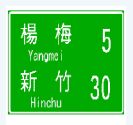
772. What is the meaning of the green background with white text sign on the expressway shown in theimage? (A) It indicates directions to two exits ahead, which are Yangmei and Hsinchu, with distances of 5km and 30 km to those exits respectively. (B) It indicates that the minimum speed limit for this section is 5km/h and the maximum speed limit is 30 km/h. (C) It indicates that both Yangmei and Hsinchu are weighstation locations, and the rest stop is 30 km away.
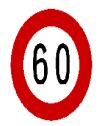
773.What is the meaning of the sign with a red circle and white background shown in the image? (A) Minimumspeed limit. (B) Maximum speed limit. (C) Maintain a safe distance of 50 metres.
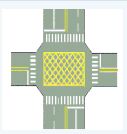
774. The yellow grid lines painted at an intersection represent a prohibition against which of the followingbehaviours? (A) Notifying vehicle drivers that temporary stopping is prohibited within the marked area,and the intersection must be kept clear. (B) Notifying that the area is a designated bus stop zone. (C)Notifying that overtaking is prohibited on this road section.
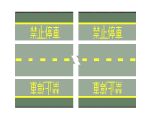
775.When a driver encounters a red light, they must stop and wait before the stop line. Which of the followingcorrectly describes the proper stopping position? (A) The front wheels of the vehicle should be alignedwith the stop line to give the driver the best intersection visibility. (B) The entire vehicle must stop behindthe stop line, and no part of the vehicle may cross it. (C) Only the rear axle needs to remain behind thestop line; the front of the vehicle extending beyond the stop line does not constitute a violation.
776.A driver traveling on a road marked with a double solid yellow center line (directional restriction line)wishes to turn left into a lane on the opposite side. What should the driver do? (A) After activating the leftturn signal, the driver may cross the double solid yellow line and turn left into the lane. (B) The drivermust not cross the double solid yellow line and should find another appropriate legal intersection to makea U-turn or take a detour. (C) When the vehicle speed is below 20 km/h, the driver may briefly cross thedouble solid yellow line to turn left.
777.On a freeway or expressway, what is the lane designated for vehicles to travel straight called? (A)Deceleration lane. (B) Climbing lane. (C) Main travel lane.
778. When driving at high speed, how does the driver's dynamic vision change? (A) Vision remains the sameNo. Ans Questionas at idle speed, with no effect whatsoever. (B) The faster the speed, the wider the driver's field of visionand the clearer the distant scenery. (C) The faster the speed, the narrower the driver's field of viewbecomes (tunnel vision effect), significantly reducing sensitivity to objects on both sides.
779.What does a solid yellow line marked at the edge of the road indicate? (A) No stopping line (equivalent toa red curb; temporary stopping is prohibited). (B) No parking line (yellow line; brief temporary stopping ispermitted). (C) Yield line.
780.When a vehicle is traveling on a freeway, expressway, or a road with controlled access points, and failsto maintain the required safe following distance, which of the following penalties is correct? (A) A fine ofNT$1,200–2,400 and suspension of the driver's license for 1 month. (B) A fine of NT$3,000–6,000. (C) Afine of NT$6,000–12,000 and immediate revocation of the driver's license on the spot.No. Ans Question
781.When driving inside a tunnel: (A) No lights needed during daytime; lights only at night to save electricity.(B) Turn on lights and slow down for safety. (C) Turn on headlights and drive at the designated speedlimit.
782. May a vehicle in the inner lane use the outer lane to overtake? (A) No. (B) Yes. (C) No regulation.
783.When encountering another vehicle on a narrow road: (A) Rush ahead to force the other to yield. (B) Slowdown and find a wider section to stop and yield. (C) Honk loudly to warn the other to yield.
784.On a two-lane two-way road, if you intend to overtake the vehicle ahead but see an oncoming vehicle: (A)Immediately slow down and abandon the overtake. (B) Immediately speed up to overtake first. (C) Honkto signal the oncoming vehicle to slow down.
785.Under what circumstances may a vehicle drive on the left side of the directional dividing line? (A) Whenthere is a parked vehicle or obstacle on the right and no oncoming traffic. (B) Going uphill or downhill. (C)Preparing to park.
786.On an empty suburban road late at night with no traffic or pedestrians: (A) You may exceed the speedlimit. (B) You must still drive within the speed limit. (C) You may slightly exceed the limit but should not gotoo fast.
787.Vehicle speed shall be governed by posted speed limit signs or pavement markings. Where no suchsigns or markings are present, the speed shall not exceed 50 km/h. However, on roads without lanelines, directional separation lines, or directional restriction lines, the speed shall not exceed:(A) 40 km/h(B) 50 km/h(C) 30 km/h
788.When following a vehicle approaching a railway level crossing, you should wait until the precedingvehicle has cleared by how far before crossing? (A) 5 meters. (B) A sufficient distance to safely cross. (C)15 meters.
789.After seeing a railway level crossing sign or marking, the driver should reduce speed to: (A) 15 km/h orbelow. (B) 20 km/h or below. (C) 30 km/h or below.
790.On a road with two or more lanes in the same direction, a slower small vehicle should drive in: (A) Theinner lane. (B) The outer lane. (C) The slow vehicle lane.
791.On a road with two or more lanes in the same direction, small vehicles should drive in: (A) The inner lane.(B) The outer lane. (C) Either the inner or outer lane, but must not change lanes freely.
792.The regulation for honking: (A) Must not honk more than 3 consecutive times. (B) Must not honk morethan 4 consecutive times. (C) Must not honk more than 5 consecutive times.
793. Each honk must not last longer than: (A) 2 seconds. (B) 1 second. (C) Half a second.
794.When following another vehicle in the same lane, the distance between vehicles should be: (A) At least 1meter. (B) At least 5 meters. (C) A distance that allows immediate stopping.No. Ans Question
795.Unless driving on a one-way road or designated left-side lane, on a road without directional markings: (A)Drive on the right. (B) Drive on the left. (C) Drive in the center.
796.When special circumstances require driving on the left side of the road: (A) Speed up. (B) Slow down andwatch for oncoming vehicles and pedestrians. (C) Honk frequently to alert oncoming traffic.
797.When meeting another vehicle on a steep narrow slope: (A) The downhill vehicle should yield to the uphillvehicle. (B) The uphill vehicle should yield to the downhill vehicle. (C) Neither needs to yield.
798.When meeting another vehicle on an unmarked road, railway level crossing, or poor road: (A) Speed up.(B) Slow down. (C) Drive normally.
799.When driving downhill: (A) Turn off the engine and coast in neutral to save fuel. (B) For safety, never turnoff the engine and coast in neutral. (C) No gear change needed.
800.On a two-way two-lane road with a directional restriction line: (A) You must not cross into the oncominglane. (B) You may cross into the oncoming lane. (C) You may cross if there is no oncoming traffic.
申論題 (0)
相關試卷
115年 - 汽車駕照筆試_英文 1051-1090(2026/05 更新)#145232
115年 · #145232
115年 - 汽車駕照筆試_英文 1001-1050(2026/05 更新)#145231
115年 · #145231
115年 - 汽車駕照筆試_英文 951-1000(2026/05 更新)#145230
115年 · #145230
115年 - 汽車駕照筆試_英文 901-950(2026/05 更新)#145229
115年 · #145229
115年 - 汽車駕照筆試_英文 851-900(2026/05 更新)#145228
115年 · #145228
115年 - 汽車駕照筆試_英文 801-850(2026/05 更新)#145227
115年 · #145227
115年 - 汽車駕照筆試_英文 701-750(2026/05 更新)#145225
115年 · #145225
115年 - 汽車駕照筆試_英文 651-700(2026/05 更新)#145224
115年 · #145224
115年 - 汽車駕照筆試_英文 601-650(2026/05 更新)#145223
115年 · #145223
115年 - 汽車駕照筆試_英文 551-600(2026/05 更新)#145222
115年 · #145222