阿摩線上測驗
登入
首頁
>
學士後西醫-化學
>
92年 - [無官方正解]92 高雄醫學大學學士後醫學系_招生考試試題:化學#136240
> 試題詳解
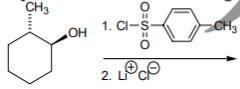
29. Choose the product of the following reaction.
(A)
(B)
(C)
(D)
(E)
答案:
登入後查看
統計:
尚無統計資料
相關試題
30. Choose those reactants and reagents that would produce 2-methyl-2-butanol as the major product.(A) (a) + (b) + (c) (B) (a) + (b) (C) (a) + (c) (D) (a) (E) (c)
#3770868
31. Choose the major product formed in the following reaction.(A) (B) (C) (D) (E)
#3770869
32. Choose the reagents that would perform the following transformation. (A) PCC (B) 1. LiAlH4/Et2O, 2. H2O/H2SO4 (C) LiCu(CH3)2 (D) CH3MgBr (E) H3PO4
#3770870
33. Choose the reactants and reagents that would produce 1-butene as the major product.(A) (a) + (b) (B) (b) (C) (a) (D) (c) (E) (a) + (c)
#3770871
34. Normally, heating an initial aldol product (the β-hydroxyaldehyde) causes dehydration. However, heating the compound below with base does not cause dehydration, but rather, decomposition to form 2-ethylbutanal. This is because: (A) There are no protons β to the carbonyl. (B) There are no protons adjacent to the OH, and the dehydration reaction requires E1 conditions. (C) There are no protons α to the carbonyl, and aldol condensations are reversible. (D) Heating any organic compound above room temperature causes decomposition. (E) None of these is true.
#3770872
35. Choose the correct statement given the following information:(A) Fe2+(aq) is more likely to be oxidized than Fe2+ complexed to CN-.(B) Fe3+(aq) is more likely to be reduced than Fe3+ complexed to CN-.(C) Both A and B are true.(D) Complexation of Fe ion with CN-has no effect on their tendencies to become oxidized or reduced.(E) None of these is true.
#3770873
36. Which of the following additions to 2-methylpropene occurs with anti-Markovnikov orientation?(A) Catalytic hydrogenation (H2/Pt) (B) Addition of HOBr (C) Addition of HI(D) Addition of HBr in the presence of ROOR (E) Oxymercuration-Demercuration
#3770874
37. Which of the following alcohols will react most rapidly with the Lucas reagent?(A) (CH3)3COH (B) CH3CH2CH2CH2OH (C) CH3CH(OH)CH2CH3(D) (CH3)2CHCH2OH (E) (CH3)3CCH2OH
#3770875
38. Which of the following dienes would undergo a Diels-Alder reaction?(A) 3-methylenecyclohexene (B) 3-methyl-1,4-cyclohexadiene (C) 2-methyl-1,3-cyclohexadiene(D) 1,4-cyclohexadiene (E) 4-methylenecyclohexene
#3770876
39. Which of the following is the strongest acid?(A) 1-pentene (B) 2-pentene (C) 1,4-pentadiene (D) cyclopentadiene (E) cycloheptatriene
#3770877
相關試卷
115年 - 115 國立中興大學_學士後醫學系公費生招生考試試題:化學科#138024
2026 年 · #138024
114年 - 114 國立中興大學_公費生招生考試_學士後醫學系:化學#126482
2025 年 · #126482
113年 - 113 國立中興大學_公費生招生考試_學士後醫學系:化學科#119556
2024 年 · #119556
112年 - 112 國立中興大學_學士後醫學系招生考試試題_學士後醫學系甲、乙組:化學#113979
2023 年 · #113979
109年 - 109 高雄醫學大學_學士後醫學系招生考試:化學#87230
2020 年 · #87230
108年 - 108 高雄醫學大學_學生轉系考試試題:普通化學#86806
2019 年 · #86806
108年 - 108 學士後西醫:化學#77055
2019 年 · #77055
107年 - 高雄醫學大學 107 學年度學士後醫學系招生考試試題(共同科目)--化學#75186
2018 年 · #75186
106年 - 106 高雄醫學大學_學士後醫學系招生考試:化學#77049
2017 年 · #77049
99年 - 學士後西醫化學99化學#36021
2010 年 · #36021
 阿摩線上測驗
登入
阿摩線上測驗
登入
阿摩線上測驗
登入
阿摩線上測驗
登入