 阿摩線上測驗
47 對於管理者應具備的能力而言,「看懂財務報表」是一種什麼能力?
(A)觀念化能力
(B)技術能力
(C)人際關係能力
(D)政治能力
統計: A(2356), B(8053), C(16), D(9), E(0) #843218
詳解 (共 10 筆)

資料來源:志光公孫策103年8月版ISBN9789861284774,第1-21頁

從複雜事務中釐清問題發展解決方案的能力,是管理者應具備技能中的哪一種能力?
A.技術能力
B.人際關係能力
C.概念化能力
D.政治能力
答案:C
出自台灣菸酒103年從業職員及從業評價職位人員-企業管理概論 第38題


題目是:「看懂財務報表」又不是會編製財務報表,既然他寫"看懂"我覺得答案是"觀念性",如果他改"編製"那答案才是"技術性",沒有人去申訴嗎?


用學的就學得會就是技術
舉例
你在大學如果有學過怎麼看財務報表
那你畢業了也就當然握有「看懂財務報表」這個技能
但是就算你看了一堆什麼「搞好人際關係的一百種方法」等等等等之類的
你還是個邊緣人
這就是學得會跟學不會的差別
而概念化能力更像將知識與經驗融合出來的產物
概念化能力與技術最大的差別就是
你讓一群人看財務報表 他們會給你同樣的答案
但假如你讓他們去進行投資
他們會因為每個人的經驗差異、個人判斷而有不同的選擇與答案
這就是兩者最大的差別
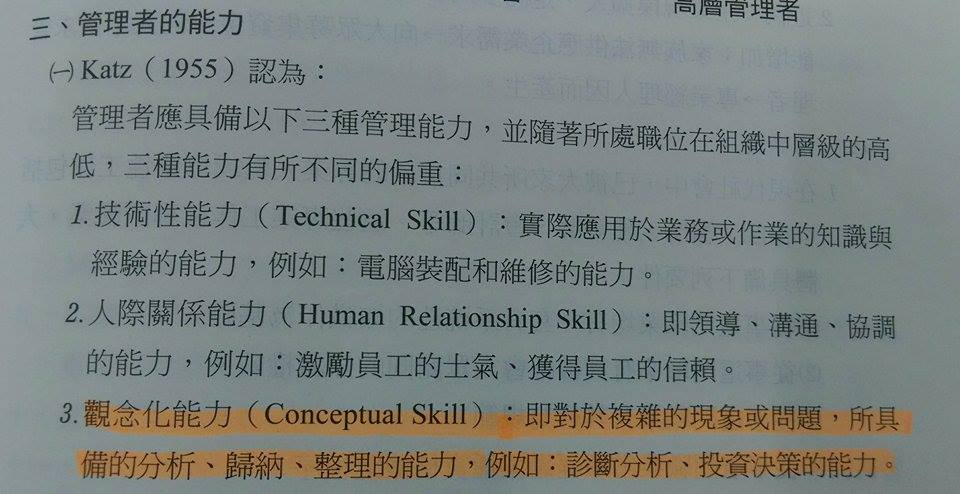
Katz’s Three-Skills Approach Katz’s(1974)seminalarticleontheskillsapproachtoleadershipsuggestedthatleadership (i.e., effective administration) is based on three skills: technical, human, and conceptual.
Technical Skills Technical skill is proficiency,based on specific knowledge,in a particular area of work.To have technical skills means that a person is competent and knowledgeable with respect to the activities specific to an organization, the organization’s rules and standard operating procedures, and the organization’s products and services (Katz, 1974; Yukl, 2006). Technical skill is most important at supervisory levels of management,less important for middle managers, and least important for top managers such as CEOs and senior managers. Finally, technical skill is proficiency in working with things.
=>做事情的專業能力。
Human Skills In contrast to technical skills, human (or interpersonal) skills are proficiency in working with people based on a person’s knowledge about people and how they behave, how they operate in groups, how to communicate effectively with them, and their motives, attitudes, and feelings. They are the skills required to effectively influence superiors, peers, and subordinates in the achievement of organizational goals. These skills enable a leader to influence team or group members to work together to accomplish organizational goals and objectives. Human skill proficiency means that leaders know their thoughts on different issues and, simultaneously, become cognizant of the thoughts of others. Consequently, leaders with higher levels of interpersonal skills are better able to adapt their own ideas to other people’s ideas, especially when this will aid in achieving organizational goals more quickly and efficiently. These leaders are more sensitive and empathetic to what motivates others,create an atmosphere of trust for their followers,and take others’needs and motivations into account when deciding what to do to achieve organizational goals. Interpersonal skills are required at all three levels of management: supervisory, middle management, and senior management (Katz, 1974;Yukl, 2006).
Conceptual Skills
Conceptual skills allow you to think through and work with ideas.Leaders with higher levels of conceptual skills are good at thinking through the ideas that form an organization and it is vision for the future,expressing these ideas in verbal and written forms,and understanding and expressing the economic principles underlying their organization’s effectiveness. These leaders are comfortable asking “what if” or hypothetical questions and working with abstract ideas.Conceptual skills allow leaders to give abstract ideas meaning and to make sense of abstract ideas for their superiors, peers, and subordinates. This skill ismostimportantfortopmanagers,lessimportantformiddlemanagers,andleastimportant for supervisory managers (Northouse, 2010).We would offer one caveat.While conceptual skills are less important at lower levels of management, to be promoted to higher levels of management, it is important to develop and demonstrate this skill at all levels of management (Yukl, 2006). It is a skill that can be learned; consequently, I encourage you to take advantage of every opportunity to develop and the ability to learn conceptually.
=>大致上文是說 明白組織的整體情況進而預測,了解、表達經濟的原則(解讀、看懂財務報表=>和其它競爭對手比較,決定出策略)=>ideas 有關。再執行。
看懂財務報表=>每個人的解讀不一定都一樣,而會做出的預測和想法和決定也不同。並不是做事情的專業能力(並沒有一定的法律和規則、技術),交給有能力的下屬去看懂財務報表解釋也可以=>明白組織情況的概念能力。
看懂財務報表=>正常看到這些字,想到的應該是明白企業經營和企業環境的關係=>抽象的概念=>概念化能力。
(雖然很多人都看的懂財務報表,但最後分析判斷後的結果,有賺有賠。)
知道如何編制報表和會計原則=>這才是技術能力吧=>學校學的到的明確的知識、教育。
技術比較具體,外科手術的執行