阿摩線上測驗
6.有關梅毒(syphilis)的處置,下列何者錯誤?
(A)神經性梅毒可能以腦膜炎、腦神經異常表現,建議使用 benzathine penicillin G 治療
(B)感染 1 年之內的早期梅毒,僅需使用 1 劑 benzathine penicillin G 治療
(C)對於 penicillin 過敏的病人,可依病況選擇 doxycycline、ceftriaxone 等替代
(D)早期梅毒經治療後應追蹤 nontreponemal test 效價以評估療效
統計: A(616), B(316), C(149), D(96), E(0) #3817521
詳解 (共 10 筆)







Long-acting IM penicillin G benzathine 不會穿過BBB,改用IV penicillin G (3 to 4 million units IV Q4H or 18 to 24 million units QD by continuous infusion) for 10 to 14 days
-
靜脈注射青黴素 G (IV Penicillin G):
-
劑量: 每 4 小時 300 萬至 400 萬單位,或每日持續輸注 1,800 萬至 2,400 萬單位。
-
療程: 連續 10 至 14 天。
-
-
針對晚期病程(如全身麻痺性癡呆、脊髓癆)的額外補充:
-
在完成 10-14 天的 IV 療程後,建議加打一劑長效型Benzathine penicillin G, IM(240 萬 units),以確保對晚期梅毒有足夠的療效覆蓋。
-
| 方案類型 | 藥物與劑量 | 途徑與頻率 | 療程長度 |
| 首選 (Preferred) | Penicillin G | IV,每 4 小時或連續輸注 | 10–14 天 |
| 替代 (首選) | Ceftriaxone | IV,每日 2g | 10–14 天 |
| 替代 (最後手段) | Doxycycline | PO,每日兩次 (200mg) | 21–28 天 |
Ref:uptodate
Treatment of neuro/ocular/otic syphilis — Neurosyphilis, ocular syphilis, and otic syphilis can occur at any time during the course of infection (table 2). (See "Neurosyphilis", section on 'Clinical manifestations' and "Syphilis: Epidemiology, pathophysiology, and clinical manifestations in patients without HIV", section on 'Clinical manifestations'.)
The treatment of ocular and otic syphilis is the same as that for neurosyphilis, even if there is no evidence of central nervous system involvement on CSF testing. Indications for CSF testing are discussed separately. (See "Syphilis: Screening and diagnostic testing", section on 'Patients with ocular/otic symptoms'.)
Long-acting IM penicillin G benzathine does not penetrate "protected sites" that sequester T. pallidum (eg, ocular structures, the central nervous system). (See 'Penicillin as the treatment of choice' above.)
Preferred regimens — Patients with ocular, otic, or neurosyphilis should be treated with IV penicillin G (3 to 4 million units IV every four hours or 18 to 24 million units per day by continuous infusion) for 10 to 14 days (table 2) [1]. The dose of IM penicillin G benzathine that is used for treatment of other stages of syphilis does not produce measurable CSF levels of the drug [50]. In addition, there are several case reports of patients with HIV who were treated with penicillin G benzathine and subsequently developed symptomatic neurosyphilis; in some of these cases, viable T. pallidum were demonstrated in CSF after IM therapy [24,25,51,52].
For patients with late disease (ie, infection felt to be present for more than a year, such as general paresis or tabes dorsalis), we typically suggest a single dose of penicillin G benzathine (2.4 million units IM) be administered after the course of IV penicillin is completed since the duration of treatment for neurosyphilis is shorter than the regimens used for other forms of late syphilis. This approach is based upon the pathophysiology of the organism, the required drug levels needed to eradicate the organism in later stages of disease, and the overall safety of the drug. However, some patients and providers may prefer to defer this additional dose since the benefit is theoretical, and there are no data to support any firm recommendations [1].
Alternative regimens
●Patients with penicillin allergy – Patients with neurosyphilis and a penicillin allergy should be evaluated to see if they can be desensitized to or rechallenged with penicillin. This way they can receive the standard IV regimen rather than using an alternative regimen (table 2). The approach to patients with a penicillin allergy is discussed elsewhere. (See "Penicillin allergy: Immediate reactions" and "Penicillin allergy: Delayed hypersensitivity reactions" and 'Preferred regimens' above.)
If desensitization or rechallenge with penicillin is not feasible, ceftriaxone (2 g IV daily for 10 to 14 days) is a reasonable alternative for those who are able to tolerate cephalosporins. The United States CDC states the dose of ceftriaxone for treatment of neurosyphilis is 1 to 2 g [1]; however, we prefer the 2 g dose since most of the studies evaluating ceftriaxone have used the 2 g dose.
Although there is much less experience with ceftriaxone compared with penicillin, observational data support the use of ceftriaxone for treatment of ocular, otic, or early neurosyphilis [53,54]. In one report of 365 patients with neurosyphilis (42 in the ceftriaxone group and 166 in the penicillin group), patients who received ceftriaxone were more likely to have a clinical response to treatment (98 versus 76 percent, respectively; crude odds ratio 13.02, 95% CI 1.73-97.66) [53]. In this trial, a similar number of patients in each group achieved an appropriate serological response at six months (88 versus 82 percent for ceftriaxone and penicillin, respectively).
On rare occasions a patient may not be able to be desensitized to penicillin or take a cephalosporin (eg, patients with Stevens-Johnson syndrome). In this setting, doxycycline (200 mg orally twice daily) for 21 to 28 days can be used. However, this regimen should be reserved for these exceptional circumstances since this regimen has very limited supporting data [55].
●Alternative to IV therapy – There are no well-established alternatives to IV therapy for treatment of neurosyphilis. Previously, penicillin G procaine (2.4 million units IM once daily) plus probenecid (500 mg orally four times a day) was an option [56], but penicillin G procaine has been discontinued worldwide.
When the diagnosis of neurosyphilis is unclear — In certain settings the diagnosis of neurosyphilis cannot be confirmed. When this occurs, the approach to treatment must be individualized and depends upon the clinical suspicion for neurosyphilis.
As an example, we would treat a patient for neurosyphilis with IV penicillin G if they had a compatible clinical syndrome, risk factors for syphilis, reactive blood serology for syphilis, and a CSF pleocytosis, even if the CSF-Venereal Disease Research Laboratory (VDRL) was not reactive. The CSF-VDRL test may be falsely negative in as many as 70 percent of patients with neurosyphilis. (See "Neurosyphilis", section on 'Diagnosis'.)
By contrast, if there is a low suspicion for neurosyphilis, we may treat for late latent syphilis (ie, three weekly doses of penicillin G benzathine 2.4 million units IM), rather than administer IV treatment. This situation typically occurs in older patients with mild cognitive deficits consistent with early dementia for whom the risk and inconvenience of sampling CSF and/or administering IV therapy may exceed the risk of undertreated neurosyphilis. If symptoms are more specific for neurosyphilis, IV penicillin can be given even when CSF sampling cannot be done.
--------------------------------------------------------------------------------------------------


正確答案:(A)
這題選錯誤的,考的是 「不同期別梅毒的藥物劑型選擇」。這是一個非常經典的陷阱題。
核心觀念:為何 (A) 是錯的?
-
錯誤點: 神經性梅毒 (Neurosyphilis) 不能 使用 Benzathine penicillin G。
-
解釋:
-
Benzathine penicillin G 是長效型肌肉注射針劑,它的優點是能在血液中維持低濃度很久,但缺點是 無法穿透血腦屏障 (BBB) 進入腦脊髓液。
-
神經性梅毒治療: 必須要讓藥物進入腦部,所以標準治療是 Aqueous crystalline penicillin G (水劑青黴素),劑量為 300-400萬單位 IV, 每 4 小時一次 (或連續輸注),通常需治療 10-14 天。
-
口訣: 只要病毒/細菌跑進腦袋(不管是上題的 HSV 腦炎還是這題的梅毒),劑量和劑型都要升級!
-
其他選項解析 (觀念都是對的)
-
(B) 感染 1 年之內的早期梅毒,僅需使用 1 劑 benzathine penicillin G 治療
-
正確。
-
對於一期 (Primary)、二期 (Secondary) 或 早期潛伏 (Early latent, <1年) 的梅毒,標準治療就是打一針 Benzathine penicillin G 2.4 million units IM 就收工。
-
-
(C) 對於 penicillin 過敏的病人,可依病況選擇 doxycycline、ceftriaxone 等替代
-
正確。
-
若非孕婦且非神經性梅毒,對青黴素過敏時,確實可用 Doxycycline (口服 14 天) 或 Ceftriaxone 作為替代方案。
-
(註:如果是孕婦或神經性梅毒,即使過敏通常也會建議做去敏感化 (Desensitization) 後繼續用 Penicillin,因為替代藥物效果較差或有毒性,但選項 C 敘述是可以接受的替代療法)。
-
-
(D) 早期梅毒經治療後應追蹤 nontreponemal test 效價以評估療效
-
正確。
-
梅毒檢驗分兩種:
-
Treponemal test (如 TPHA, TPPA): 一旦感染過就會終身陽性,不能用來看療效。
-
Nontreponemal test (如 RPR, VDRL): 會隨病情好壞升降。治療成功的定義通常是效價 (Titer) 下降 4 倍以上 (例如從 1:32 降到 1:8)。
-
-
總結記憶點
-
腦袋壞掉 (神經性梅毒) $\rightarrow$ 打點滴 (Aqueous Penicillin G IV)。
-
身體壞掉 (早期梅毒) $\rightarrow$ 打屁股一針 (Benzathine Penicillin G IM)。
-
不知道壞多久 (晚期/不明潛伏) $\rightarrow$ 打屁股三針 (一週一針,共三週)。

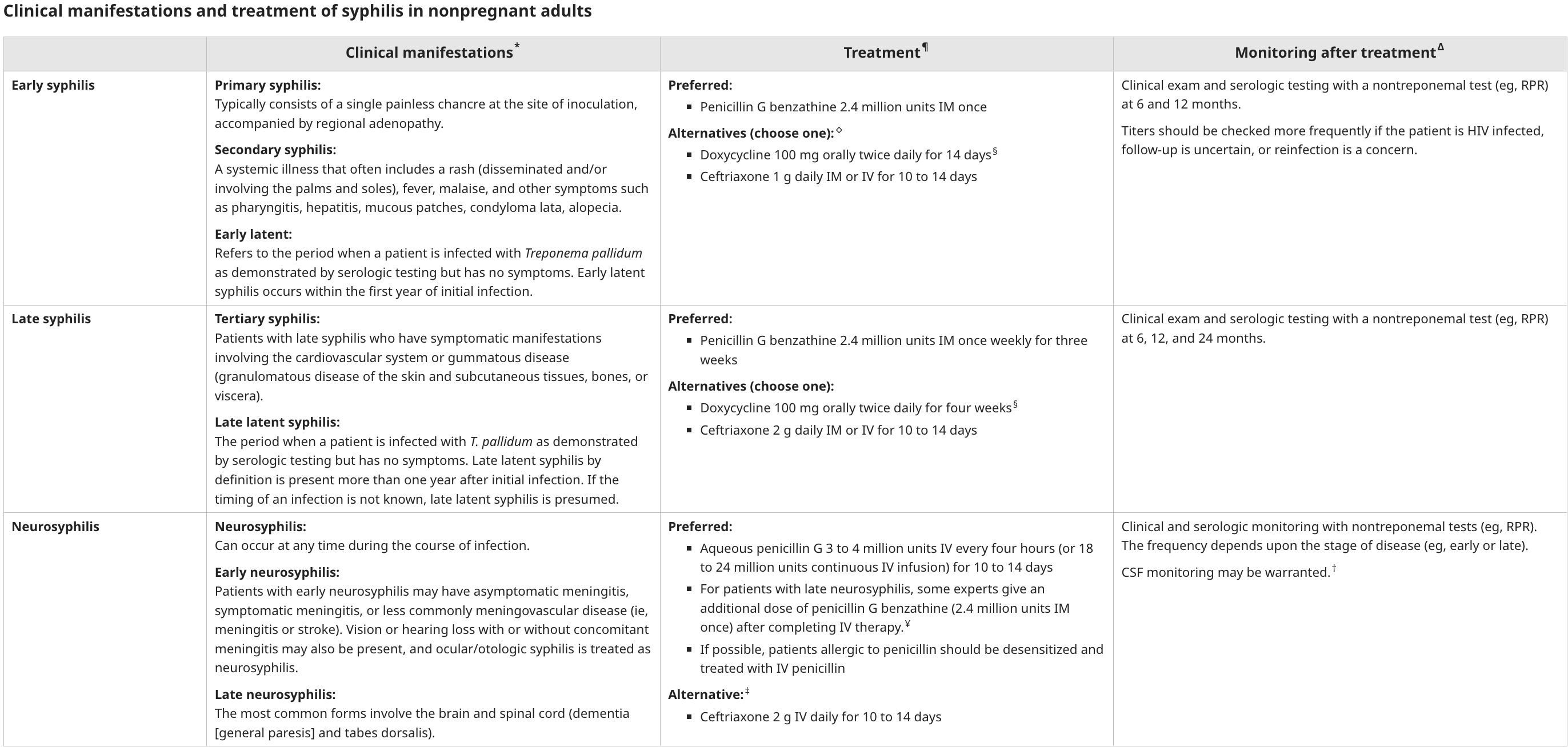 ref: uptodate - Clinical manifestations and treatment of syphilis in nonpregnant adults