阿摩線上測驗
登入
首頁
>
研究所、轉學考(插大)◆有機化學及無機化學
>
115年 - [無官方正解]115 國立中山大學_碩士班考試入學招生考試試題_化學系:有機化學及無機化學#138420
> 申論題
題組內容
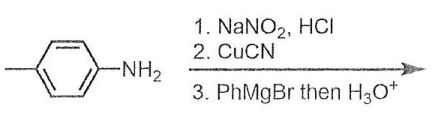
2. Draw the major organic product for the following reactions. (12%)
c)
申論題作答 (共 1 筆)
依時間顯示最近 1 筆。
一起撐住一起上榜
申論題作答 #69789
37 分
37
總分
題意符合度
40分
論證結構
30分
語言表達
45分
26秒
總時間
0
人解鎖
2026.06
作答大綱
重氮鹽反應、桑德邁爾反應(Sandmeyer Reaction)以及格氏試劑(Grignard Rea...
正文
前往查看作答內容
查看完整內容
相關申論題
d)
#566748
3. Draw a reasonable mechanism for the following transformation. (3%)
#566749
4. Provide a stepwise synthesis (give reagents) for the following transformation. (3%)
#566750
5. Cubic close packing (ccp) and hexagonal close packing (hcp) are two common closest-packed structures. Explain the key differences between ccp and hcp. (4%)
#566751
a) Please determine whether the unknown crystalline sample is simple cubic, face-centered cubic (fcc), or body-centered cubic (bcc). Explain your reasons.
#566752
b) Please give the possible (hkl) of x, y, and z.
#566753
c) If a very weak peak appears at 2θ=30.5° (relative intensity 1%), how would you determine whether it arises from a second/impure phase, or it still corresponds to a single phase? (10%)
#566754
7. A molecular orbital diagram of a ML6 octahedral complex with sigma-donor and pi-acceptor interaction is shown below. Please fill out all the square blank fields (i - xx) with the proper irreducible representation. (6%)Please give your answer with the corresponding label of the empty field.Note: sigma-donor symmetry representation: A1g, Tlu, Egpi-acceptor symmetry representation: T1g, T2g, Tlu, T2uThe figure credit: adapted from 5th Ed. "Inorganic Chemistry" by Gary L. Miessler
#566755
VI. Curriculum DesignPlease read the article ”Kyoto: The Heart of Japan,” and identify ONE writing feature (e.g. choice of words, descriptive flow or overall organization) that you find effective in demonstrating strong writing skills. Next, design a TWO-period lesson plan in which you guide 11th -grade students at TNGS to learn and apply this feature in their own writing. Your lesson plan should be as clear, detailed and specific as possible. Kyoto, like a beauty in a bright and colorful kimono, delights tourists throughout the year. In spring, romance is in the air as the city is filled with a sea of pink cherry blossoms. In summer, greenleaves can be heard rustling in the wind and seen sparkling in the sunshine. Maple leaves in autumn set the landscape on fire with orange and red colors. Then, when winter comes, white snow turns the whole city into a magic, silver kingdom. Apart from its natural splendor, Kyoto has so much more to feast one’s eyes on. Having previously been the capital of Japan for over a thousand years, the city boasts a large number of historic shrinesand temples. No visit to Kyoto would be complete without seeing one of the most photographed landmarks: the Kinkaku-ji, or the Golden Pavilion Temple in English. With giant, leafy maple treesleading up to its main entrance, what comes into view is this magnificent three-story pavilion. Rising up behind a crystal-clear pond, it is covered in sparkling gold leaf and crowned with a large bronzephoenix on its shimmering roof. The reflection of the pavilion on the glassy surface of the pond is a breathtaking sight. Visitors can take a leisurely walk through the surrounding gardens and enjoymany stunning views of this beautiful structure. Another unforgettable Kyoto sight involves coming face to face with one of the old capital’s very special “persons of art,” or geishas. These are women dressed in delicate kimonos with silk sleeves.Their distinctive white makeup, bright red lipstick, and graceful hairpins also make them easy to recognize. And it’s not just their unique appearance that makes geishas stand out from the crowd.These highly skilled entertainers spend years mastering different musical instruments, songs, and literature. Of course, no “person of art” could be a true geisha without being able to perform thetraditional kyomai dance. This ancient art combines slow music with very deliberate movements, and often expresses very deep emotion. In Kyoto, culture and natural beauty flow together like the graceful motions of kyomai.Regardless of the season, the city is a must-see destination for tourists seeking an authentic localexperience. Those who visit are likely to end up falling in love with the heart of Japan.
#566756
VII. Essay questions You are the homeroom teacher of a bilingual class at TNGS. Your student, Elena, has written to you seeking advice. Please reply to her letter as Mr. or Ms. E. Dear Mr./Ms. E, This is Elena Lin from your homeroom. I hope this letter finds you well. I'm writing to you because I don't quite know who else to turn to, and you've always seemed like someone who genuinely cares about usbeyond just our grades. I know you probably see me as the girl who's always got her nose buried in a novel or passionately arguing some point at debate practice — and honestly, that's the part of school I love most. Being presidentof the debate club, diving into To Kill a Mockingbird or dissecting the themes in The Great Gatsby — that's where I feel most like myself. Words make sense to me. Stories make sense to me. Numbers and chemical equations, however, do not. I want to be a doctor. My mom is a physician, and watching her work — the way she actually helps people on their worst days — has inspired me for as long as I can remember. I've never wanted anythingelse. But lately, every time I sit down with my Math or Chemistry textbook, that dream feels a little further away. My last Chemistry test came back with a grade I'm honestly too embarrassed to write here, andCalculus feels like it's written in a language I was never taught to speak. What frightens me most is college applications. I look at the admission requirements for medical programs and my stomach just drops. I can write a personal essay that I'm proud of. I can debate both sidesof a complex argument without flinching. But will I meet the rigorous entrance exam standards required by the medical school? I've been losing sleep over this. I’ve been skipping some meals just to squeeze in extra studying, and I still don't feel like it's enough. I don't want to disappoint my mother. I don't want to disappoint myself. I was hoping you might be able to give me some advice. Should I be seeking tutoring? Is there a way to structure my studying more effectively? Are there things I can do now, in my second year in high school toimprove my grades? I trust your judgment more than I can say. You know this school, you know how colleges think, and more importantly, you know your students. I'd be so grateful for any guidance you're willing tooffer. Thank you so much for reading this far. I'm sorry if it's a bit of a ramble — debate teaches you to argue concisely, but apparently writing about your own fears is harder than arguing against them. Sincerely, Elena
#566757
相關試卷
115年 - [無官方正解]115 國立中山大學_碩士班考試入學招生考試試題_化學系:有機化學及無機化學#138420
115年 · #138420
114年 - [無官方正解]114 國立中山大學_碩士班考試入學招生考試試題_化學系:有機化學及無機化學#138439
114年 · #138439
113年 - [非官方正解]113 國立中山大學_碩士班暨碩士在職專班招生考試試題_化學系碩士班:有機化學及無機化學#119266
113年 · #119266
112年 - [非官方正解]112 國立中山大學碩士暨碩士專班招生考試_化學系碩士班:有機化學及無機化學#119263
112年 · #119263
111年 - [非官方正解]111 國立中山大學_碩士班暨碩士在職專班招生考試_化學系:有機化學及無機化學#126310
111年 · #126310
110年 - [非官方正解]110 國立中山大學碩士暨碩士專班招生考試_化學系碩士班:有機化學及無機化學#110464
110年 · #110464
109年 - [無官方正解]109 國立中山大學_碩士班考試入學招生考試試題_化學系:有機化學及無機化學#138499
109年 · #138499
108年 - [無官方正解]108 國立中山大學_碩士班考試入學招生考試試題_化學系:有機化學及無機化學#138538
108年 · #138538
107年 - [無官方正解]107 國立中山大學_碩士班考試入學招生考試試題_化學系:有機化學及無機化學#138542
107年 · #138542
105年 - [無官方正解]105 國立中山大學_碩士班暨碩士專班招生考試_化學系:有機化學與無機化學#138560
105年 · #138560
 阿摩線上測驗
登入
阿摩線上測驗
登入