所屬科目:研究所、轉學考(插大)◆普通物理學
1. The initial speed of a cannon ball is 0.20 km/s. If the ball is to strike a target that is at a horizontal distance of 3.0 km from the cannon, what is the minimum time of flight for the ball? (A) 16 s (B) 35 s (C) 28 s (D) 4 s (E) 49 s
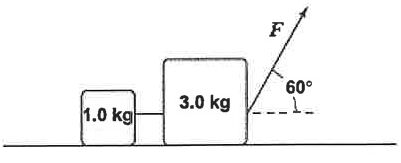
2. Two blocks connected by a string are pulled across a horizontal surface by a force applied to one of the blocks, as shown in right. The coefficient of kinetic friction between the blocks and the surface is 0.25. If each block has an acceleration of 2.0 m/s² to the right, what is the magnitude F of the applied force? (1.0 kg and 3.0 kg blocks, F at 60°)
(A) 12 N (B) 25 N (C) 34 N (D) 43 N (E) 7 N
3. A force acting on an object moving along the x axis is given by Fx = (14x − 3.0x²) N, where x is in m. How much work is done by this force as the object moves from x = −1 m to x = +2 m? (A) +12 J (B) +28 J (C) +40 J (D) +42 J (E) −28 J
4. A 3.50-kg block is pulled along a moving conveyor belt at a constant speed of 0.500 m/s relative to a stationary observer, while the belt moves at a constant speed of 0.200 m/s in the same direction. If the coefficient of kinetic friction is 0.400, the magnitude of the mechanical energy dissipated, in J, caused by the force of friction on the block in 8.00 s is (A) 5.6 (B) 22.0 (C) 32.9 (D) 54.8 (E) 76.8
5. A 3.0-kg block is on a horizontal surface. The block is at rest when, at t = 0, a force (magnitude P = 12 N) acting parallel to the surface is applied to the block, causing it to accelerate. The coefficient of kinetic friction between the block and the surface is 0.20. At what rate is the force P doing work on the block at t = 2.0 s? (A) 58 W (B) 49 W (C) 39 W (D) 64 W (E) 18 W
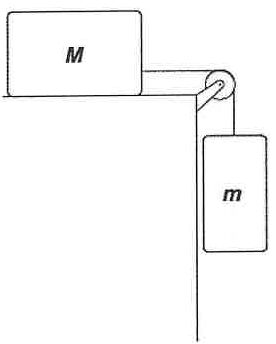
6. A mass m = 4.0 kg is connected, as shown, by a light cord to a mass M = 6.0 kg, which slides on a smooth, horizontal surface. The pulley rotates about a frictionless axle and has a radius R = 0.12 m and a moment of inertia I = 0.090 kg·m². The cord does not slip on the pulley. What is the magnitude of the acceleration of m?
(A) 2.4 m/s² (B) 3.8 m/s² (C) 5.2 m/s² (D) 4.5 m/s² (E) 1.1 m/s²
7. An airplane traveling at half the speed of sound emits sound at a frequency of 5000 Hz. At what frequency does a stationary listener hear the sound as the plane approaches, and after it passes by? Assume the airplane is not flying very high. (A) 5000 Hz, 6000 Hz (B) 3000 Hz, 6666 Hz (C) 4000 Hz, 2333 Hz (D) 10000 Hz, 3333 Hz (E) 7000 Hz, 9000 Hz
8. A 100-g cube of ice is heated from −120 °C to +120 °C. In which of the following processes is the greatest amount of energy absorbed by this material? (A) warming ice to the melting point (B) melting the ice to become water (C) warming the resulting water (D) vaporizing the water to become steam (E) heating the steam
9. For the same temperature increase in a system, the change in entropy, ΔS, is largest in a reversible (A) constant-volume process. (B) constant-pressure process. (C) adiabatic process. (D) process in which no heat is transferred. (E) process in which no work is performed.
10. Two tanks of gas, one of hydrogen, H₂, and one of helium, He, contain equal masses of gas. The gram-molecular mass of He is twice that of H₂. Both tanks of gas are at the same temperature, 293 K. Which statement(s) below is(are) correct when we ignore vibrational motion? (A) The total internal energy of the hydrogen is the same as that of the helium. (B) The total internal energy of the hydrogen is 167 times that of the helium. (C) The total internal energy of the helium is 1.67 times that of the hydrogen. (D) The total internal energy of the hydrogen is 3.33 times that of the helium. (E) The total internal energy of the helium is 3.33 times that of the hydrogen.
11. A nonuniform linear charge distribution given by λ(x) = bx, where b is a constant, is distributed along the x axis from x = 0 to x = +L. If b = 40 nC/m² and L = 0.20 m, what is the electric potential (relative to a potential of zero at infinity) at the point y = 2L on the y axis? (A) 45 V (B) 17 V (C) 24 V (D) 32 V (E) 8 V
12. A long, nonconducting cylinder (radius = 6.0 mm) has a nonuniform volume charge density given by αr², where α = 6.2 mC/m⁵ and r is the distance from the axis of the cylinder. What is the magnitude of the electric field at a point 2.0 mm from the axis? (A) 0.4 N/C (B) 3.6 N/C (C) 0.8 N/C (D) 2.5 N/C (E) 1.4 N/C
13. A 6.0-μF capacitor charged to 50 V and a 4.0-μF capacitor charged to 34 V are connected to each other, with the two positive plates connected and the two negative plates connected. What is the total energy stored in the 6.0-μF capacitor at equilibrium? (A) 8.1 mJ (B) 6.7 mJ (C) 4.6 mJ (D) 5.7 mJ (E) 2.8 mJ
14. A charged particle (m = 5.0 g, q = −70 μC) moves horizontally at a constant speed of 30 km/s in a region where the free-fall gravitational acceleration is 9.8 m/s² downward, the electric field is 700 N/C upward, and the magnetic field is perpendicular to the velocity of the particle. What is the magnitude of the magnetic field in this region? (A) 23 mT (B) zero (C) 47 mT (D) 35 mT (E) 12 mT
15. Two long, straight, parallel wires separated by a distance of 20 cm carry currents of 30 A and 40 A in opposite directions. What is the magnitude of the resulting magnetic field at a point that is 15 cm from the wire carrying the 30-A current and 25 cm from the other wire? (A) 51 μT (B) 33 μT (C) 72 μT (D) 64 μT (E) 46 μT
16. A spherical particle of density ρ = 5.00 g/cm² and 2.00-mm radius is located at the same distance from the Sun as the Earth, where RSE = 1.5 × 10¹¹ m and S = 1365 W/m². If the particle absorbs 100 percent of the sunlight reaching it, the ratio of the force exerted by the solar radiation to the force of gravity exerted on the particle by the Sun is (A) 5.8 × 10⁻⁵ (B) 0.58 (C) 1.0 (D) 1.7 (E) 1.7 × 10⁴
17. In a double-slit experiment, the distance between the slits is 0.2 mm, and the distance to the screen is 150 cm. What wavelength (in nm) is needed to have the intensity at a point 1 mm from the central maximum on the screen be 80% of the maximum intensity? (A) 900 (B) 700 (C) 500 (D) 300 (E) 600
18. A spaceship from another galaxy passes over the solar system directly above a radial line from the Sun to the Earth. (We measure that distance to be 1.5 × 10¹¹ m.) On Earth, the spaceship is observed to be traveling at a speed of 0.80c, for which γ = 5/3. As measured on Earth it takes the spaceship 625 seconds to travel from the Sun to Earth. When a scientist in the spaceship measures the Earth-sun distance and the time it takes her to travel that distance, she finds the results are, respectively, (A) 1.5 × 10¹¹ m; 625 s. (B) 9.0 × 10¹⁰ m; 625 s. (C) 9.0 × 10¹⁰ m; 375 s. (D) 2.5 × 10¹¹ m; 625 s. (E) 2.5 × 10¹¹ m; 1042 s.
19. Frank says that quantum mechanics does not apply to baseballs because they do not jump from quantum state to quantum state when being thrown. Francine agrees with him. She says that there is no uncertainty in a baseball's position or momentum. Are they correct, or not, and why? (A) They are correct because the first excited state of a baseball is at a higher energy that any baseball ever receives. Therefore, we cannot determine whether or not there is uncertainty in its position or momentum. (B) They are correct because the first excited state of a baseball is at a higher energy that any baseball ever receives. Therefore, its position and momentum are completely uncertain until it is caught. (C) They are wrong because the baseball goes through so many quantum states in being thrown that we cannot observe the transitions. The uncertainties in its position and momentum are too small to observe. (D) They are wrong because the baseball goes through so many quantum states in being thrown that we cannot observe the transitions. Because of the number of transitions its position and momentum are completely uncertain until it is caught. (E) Quantum mechanics states that they are correct as long as they do not make any observations, but wrong as soon as they begin to make observations.
20. An electron has been accelerated by a potential difference of 100 V. If its position is known to have an uncertainty of 1 nm, what is the percent uncertainty × 100% of the electron? (A) 1% (B) 8% (C) 10% (D) >>10% (E) 5%
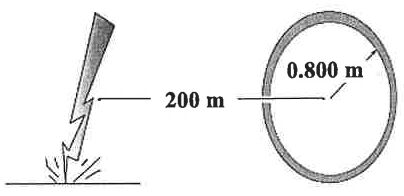
1. A bolt of lightning strikes the ground 200 m from a 100-turn coil oriented vertically and with the plane of the coil pointing toward the lightning strike. The radius of the coil is 0.800 m and the current in the lightning bolt falls from 6.00 × 10⁶ A to zero in 10.5 μs. What is the voltage induced in the coil over this time period?
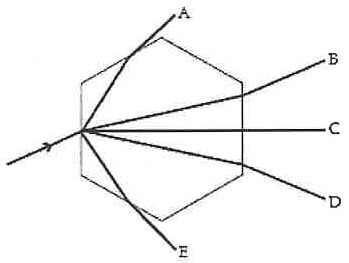
2. A light ray strikes a hexagonal ice crystal floating in the air at a 30° angle to one face, as shown below. The hexagonal faces of the crystal are perpendicular to the plane of the page. All the rays shown are in the plane of the page, and nice = 1.30. Which outgoing ray is the correct one?
3. A uniform linear charge of 2.0 nC/m is distributed along the x axis from x = 0 to x = 3 m. Please write the integral for the x component of the electric field at y = 2 m on the y axis?
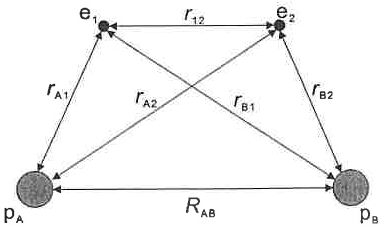
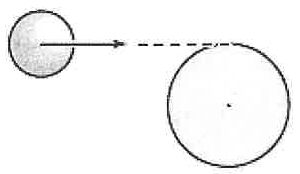
4. The diagram shown in right indicates the distances between the nuclei, pA and pB, and the electrons, e₁ and e₂, in a hydrogen molecule. What is the electrostatic potential energy the electrostatic potential energy of this molecule that we would expect?
5. A Styrofoam container used as a picnic cooler contains a block of ice at 0 °C. If 225 grams of ice melts in 1 hour, how much heat energy per second is passing through the walls of the container? (The heat of fusion of ice is 3.33 × 10⁵ J/kg).
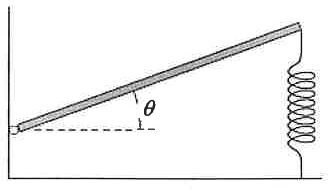
6. A horizontal plank (m = 2.0 kg, L = 1.0 m) is pivoted at one end. A spring (k = 1.0 × 10³ N/m) is attached at the other end, as shown in the figure. Find the angular frequency (in rad/s) for small oscillations.
7. A particle of mass m = 0.10 kg and speed v₀ = 5.0 m/s collides and sticks to the end of a uniform solid cylinder of mass M = 1.0 kg and radius R = 20 cm. If the cylinder is initially at rest and is pivoted about a frictionless axle through its center, what is the final angular velocity (in rad/s) of the system after the collision?
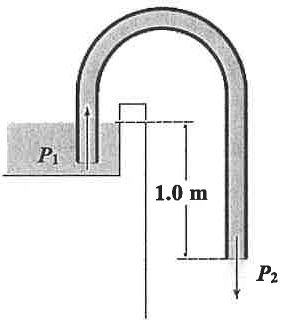
8. The siphon shown is used to transfer liquid from a higher level to a lower level. If the fluid is drawn up and is continuous through the tube, please determine the velocity of flow of gasoline if the vertical distance from the liquid surface to the outlet is 1.0 m.
 阿摩線上測驗
登入
 (A) 12 N (B) 25 N (C) 34 N (D) 43 N (E) 7 N
 (A) 2.4 m/s² (B) 3.8 m/s² (C) 5.2 m/s² (D) 4.5 m/s² (E) 1.1 m/s²
 × 100% of the electron? (A) 1% (B) 8% (C) 10% (D) >>10% (E) 5%