所屬科目:研究所、轉學考(插大)◆普通物理學
1. Which of the curves on the graph best represents the vertical component v_y of the velocity versus the time t for a projectile fired at an angle of 45° above the horizontal?
(A) OC (B) AE (C) AB (D) DE (E) AF
2. The coefficient of static friction between the block and the cart is 0.5. If the mass of the block is m, what is the minimal acceleration of the cart to prevent the block from falling?
(A) g (B) 0.6 (C) 0.3g (D) 0.5g (E) 2g
3. An object of mass m is initially at rest on a frictionless horizontal plane. If a constant power P acts on this object for t duration, how far will it travel during this interval? (A)(B) (C)(D) (E)
4. A uniform narrow bar, resting on ice, is given a transverse horizontal impulse at one end as shown. The center of mass will:
(A) remain at rest (B) move in a circle (C) move in a straight line (D) move in a parabola (E) none of above
5. Two objects, X and Y, are held at rest on a horizontal frictionless surface and a spring is compressed between them. The mass of X is 5/2 times the mass of Y. Immediately after the spring is released, X has a kinetic energy of 50 J and Y has a kinetic energy of: (A) 20 J (B) 8 J (C) 310 J (D) 125 J (E) 50 J
6. Where is the CM of the thin semicircular ring in the figure? The mass is uniformly distributed.
(A) (0, R/π) (B) (0, 2R/π) (C) (0, 3R/π) (D) (0, R/2π) (E) (0, R/3π)
7. A solid wheel with mass M, radius R, and rotational inertia MR²/2, rolls without sliding on a horizontal surface. A horizontal force F is applied to the axle and the center of mass has an acceleration a. The magnitudes of the applied force F and the frictional force f of the surface, respectively, are: (A) F = Ma, f = 0 (B) F = Ma, f = Ma/2 (C) F = 2Ma, f = Ma (D) F = 2Ma, f = Ma/2 (E) F = 3Ma/2, f = Ma/2
8. The mass density of a certain planet has spherical symmetry but varies in such a way that the mass inside every spherical surface with center at the center of the planet is proportional to the radius of the surface. If r is the distance from the center of the planet to a point mass inside the planet, the gravitational force on the mass is: (A) not dependent on r (B) proportional to r (C) proportional to r² (D) proportional to 1/r (E) proportional to 1/r²
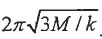
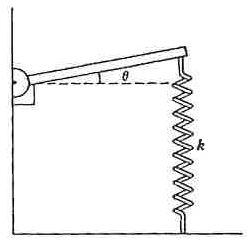
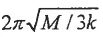
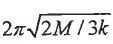
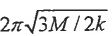
9. A uniform rod of mass M and length L is pivoted about a horizontal axis at one end and attached to a vertical spring whose constant is k. For small angle displacements from the equilibrium position (indicated by the dashed line), what is the period of the oscillation? (Irod = ML²/3)
(A) (B) (C)(D)(E)
10. An ideal gas, consisting of n moles, undergoes an irreversible process in which the temperature T has the same value at the beginning and end. If the volume changes from Vi to V_f, the change in entropy is given by: (A) nR (Vf−Vi) (B) nR (Vf/Vi) (C) nR ln(Vf/Vi) (D) nR ln(Vi/Vf) (E) none of the above (entropy can't be calculated for an irreversible process)
11. A small metal sphere is suspended from the conducting cover of a conducting metal ice bucket by a non-conducting thread. The sphere is given a negative charge before the cover is placed on the bucket. The bucket is tilted by means of a non-conducting material so that the charged sphere touches the inside of the bucket. Which statement is correct? (A) The negative charge remains on the metal sphere. (B) The negative charge spreads over the outside surface of the bucket and cover. (C) The negative charge spreads over the inside surface of the bucket and cover. (D) The negative charge spreads equally over the inside and outside surfaces of the bucket and cover. (E) The negative charge spreads equally over the sphere and the inside and outside surfaces of the bucket and cover.
12. Charge of uniform density (20 nC/m²) is distributed over a cylindrical surface (radius = 1.0 cm), and a second coaxial surface (radius = 3.0 cm) carries a uniform charge density of −12 nC/m². Determine the magnitude of the electric field at a point 4.0 cm from the symmetry axis of the two surfaces. (A) 0.45 kN/C (B) 1.25 kN/C (C) 2.75 kN/C (D) 3.25 kN/C (E) 4.65 kN/C
13. A nonuniform linear charge distribution given by λ(x) = bx, where b is a constant, is distributed along the x axis from x = 0 to x = +L. If b = 40 nC/m² and L = 0.20 m, what is the electric potential (relative to a potential of zero at infinity) at the point y = 2L on the y axis? (A) 28 V (B) 17 V (C) 46 V (D) 52 V (E) 65 V
14. A 0.16-pF parallel-plate capacitor is charged to 10 V. Then the battery is disconnected from the capacitor. When 1.00 × 10⁷ positive charges of magnitude |e| are now placed on the positive plate of the capacitor, the voltage between the plates changes by (A) −5.0 V (B) −1.1 V (C) 0 V (D) +1.1 V (E) +5.0 V
15. Light bulb A is rated at 60 W and light bulb B is rated at 100 W. Both are designed to operate at 110 V. Which statement is correct? (A) The 60-W bulb has a greater resistance and greater current than the 100-W bulb. (B) The 60-W bulb has a greater resistance and smaller current than the 100-W bulb. (C) The 60-W bulb has a smaller resistance and smaller current than the 100-W bulb. (D) The 60-W bulb has a smaller resistance and greater current than the 100-W bulb. (E) We need to know the resistivities of the filaments to answer this question.
16. The reason the north pole of a bar magnet free to rotate points north is because (A) the south geographic pole of the earth is the earth's magnetic north pole. (B) the south geographic pole of the earth is the earth's magnetic south pole. (C) there is a net accumulation of negative magnetic charge at the earth's south geographic pole. (D) there is a net accumulation of positive magnetic charge at the earth's north geographic pole. (E) the north geographic pole of the earth is the earth's magnetic north pole.
17. After a switch is thrown to remove the battery from a DC LR circuit, but the circuit is still left complete, the time constant represents (A) the time rate of change of the current in the circuit. (B) the time rate of change of the induced emf in the circuit. (C) the magnitude of the ratio of the current to the time rate of change of the current. (D) all of the above. (E) only (a) and (b) above.
18. The Sun radiates energy at a rate of 3.86 × 10²⁶ W. Its radius is 7.0 × 10⁸ m. If the distance from the Earth to the Sun is 1.5 × 10¹¹ m, what is the intensity of solar radiation at the top of the Earth's atmosphere? (A) 1.6 × 10 W/m² (B) 2.8 × 10⁴ W/m² (C) 3.6 × 10⁵ W/m² (D) 1.4 × 10³ W/m² (E) 6.4 × 10⁷ W/m²
19. A magician can make a candle look as if it is burning under water by focusing light from a candle flame burning in air directly on top of an underwater candle. To do this you want to use (A) a biconcave lens farther than one focal length from the burning candle. (B) a convex mirror farther than one focal length from the burning candle. (C) concave mirror farther than one focal length from the burning candle. (D) a concave mirror closer than one focal length to the burning candle. (E) a convex lens closer than one focal length to the burning candle.
20. An electron has been accelerated by a potential difference of 100 V. If its position is known to have an uncertainty of 1 nm, what is the percent uncertainty (Δp/p × 100 %) of the electron? (A) 1% (B) 10% (C) >>10% (D) 20 % (E) <<1%
 阿摩線上測驗
登入
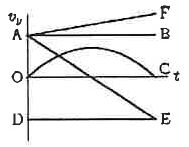 (A) OC (B) AE (C) AB (D) DE (E) AF
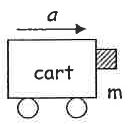 (A) g (B) 0.6 (C) 0.3g (D) 0.5g (E) 2g
 (B)
 (C)
 (D)
 (E)

 at one end as shown. The center of mass will:
 (A) remain at rest (B) move in a circle (C) move in a straight line (D) move in a parabola (E) none of above
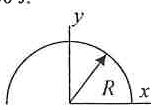 (A) (0, R/π) (B) (0, 2R/π) (C) (0, 3R/π) (D) (0, R/2π) (E) (0, R/3π)
 (A)
 (B)
 (C)
 (D)
 (E)