所屬科目:研究所、轉學考(插大)◆分子生物學
1. A eukaryotic gene is most likely to be transcribed if it is located where? (A) in the telomeric region of a chromosome (B) in a heterochromatic region of the genome (C) in a euchromatic region of the genome (D) in a region of the genome in which the histones are deacetylated
2. Sister chromatid is: (A) The same thing as homologous chromosomes. (B) A pair of chromosomes of the same kind. (C) Identical copies of the same chromosome attached at the centromere. (D) Always haploid. (E) Always diploid.
3. Which of following RNA participates in ribosome biogenesis? (A) small nucleolar RNA (B) transfer RNA (C) small nuclear RNA (D) microRNA (E) small interfering RNA
4. Which of the following enzymes is the major processive enzyme in leading strand synthesis during eukaryotic DNA replication? (A) DNA polymerase α (alpha) (B) DNA polymerase β (beta) (C) RNA polymerase γ (gamma) (D) DNA polymerase ε (epsilon) (E) Telomerase
5. Which form of DNA damage is least likely to be encountered on a day to day basis? (A) Double strand breaks. (B) Hydroxylation. (C) Deamination. (D) Pyrimidine dimers. (E) Tautomerization.
6. If a replicating cell encounters significant DNA damage during S phase, what is the most likely result? (A) It will arrest in the S phase checkpoint and undergo repair (B) It will immediately trigger apoptosis and die (C) It will utilize telomerase to extend past the damage (D) It will utilize bypass polymerases to complete S phase (E) It will undergo a reductive division
7. Which of the following is not part of a zinc-finger motif? (A) zinc ion (B) proline residue (C) cysteine residue (D) histidine residue
8. Which of the following protein domains would be most likely to recognize and bind to acetylated lysine residues on nucleosomes? (A) homeodomains (B) zinc fingers (C) bromodomains (D) chromodomains
9. Cells, when infected by a DNA virus, can transcribe both stands of the viral DNA and process it into ~21 nt single stranded fragments that can be loaded into protein complexes which target viral protein encoding transcripts for degradation. Which statement below correctly characterizes this process? (A) This siRNA silencing results in a gene knock out. (B) This siRNA silencing results in a gene knock down. (C) This miRNA silencing results in a gene knock out. (D) This miRNA silencing results in a gene knock down. (E) This miRNA silencing results in reversible gene regulation
10. The Central Dogma of molecular biology states that one gene leads to one transcript and results in one protein product. Which of the following processes would refute this dogma? (A) Ordered splicing. (B) RNA editing. (C) Telomerase activity. (D) Translation start site recognition. (E) Polyadenylation of new transcripts.
11. Which of the arrows in the diagram below best represents the position and direction of leading strand DNA synthesis? The vertical bars at the center of the diagram depict the replication origin. (A) A (B) B (C) C (D) D
12. Not all mutations inside the open reading frame of a gene encoding a protein change the amino acid sequence of the protein because: (A) tRNAs carrying different amino acids can recognize the same codon (B) some codons specify more than one amino acid (C) two different codons can specify the same amino acid (D) some codons are skipped during translation (E) some codons consist of more than three nucleotides
13. Eukaryotic protein synthesis: (A) proceeds in a 5' 3' direction (B) is coupled to transcription (C) always begins with a formyl-methionine (D) utilizes energy stored in the aminoacyl-tRNA (E) terminates at the sequence 5'-AAUAAA-3'
14. RNA molecules that exhibit catalytic activity are called (A) mRNAs (B) ribonucleases (C) ribosomes (D) ribozymes
15. Which of the following scientists provided definitive evidence for the chromosomal theory? (A) Mendel (B) Morgan (C) McClintock (D) Miescher (E) Avery
16. Which of the following would not be considered a mutation? (A) permanent replacement of guanine with thymine in a DAN strand (B) deletion of gene segment (C) insertion of an intron in the middle of an exon (D) permanent replacement of cytosin with adenine (E) crossing over of two gene regions during meiosis
17. A patient presents with α-thalessemia. Below is the mRNA transcribed from the patient's α-globin gene. What is the most likely result in this individual? Note: The ellipse (...) represents a continuation of the RNA beyond the sequence you are given.
(A) defective transcription initiation (B) normal protein, this is a silent mutation (C) defective translation initiation (D) shorter protein, this is a nonsense mutation (E) Glycine → Serine mutation in the protein
18. All the following statements about molecular chaperones are true except (A) They play a role in the proper folding of proteins. (B) They are located in every cellular compartment. (C) They are found only in mammals. (D) They bind a wide range of proteins.
19. As topoiosomerases play an important role during replication, a large number of anticancer drugs have been developed that inhibit the activity of these enzymes. Which of the following statements is NOT true about topoisomerases as a potential anticancer drug target? (A) As cancer cells are rapidly growing cells, they usually contain higher level of topoisomerases. (B) The transient DNA breaks created by topoisomerases are usually converted to permanent breaks in the genome in the presence of topoisomerase targeted drugs. (C) As cancer cells often have impaired DNA repair pathways, they are more susceptible towards topoisomerase targeted drugs. (D) The drugs that specifically target topoisomerase, usually do not affect normal fast growing cells.
20. Which one of the following statements about the chromatins is NOT true? (A) DNA winds approximately 1.65 times around the nucleosomes (B) H2A-H2B bind to both the entry and exit ends of DNA in nucleosomes (C) Covalent modification of histones influence chromatin compaction (D) Non-histone proteins are part of mitotic chromosomes
21. Gametes are _ and somatic cell are _. (A) diploid; haploid (B) haploid, diploid (C) haploid; haploid (D) diploid, diploid
22. Which two Uvr component molecules scan the DNA during nucleotide excision repair? (A) UvrB, UvrC (B) UvrC, UvrA (C) UvrD, UvrA (D) UvrA, UvrB
23. How does tyrosine recombinase acts? (A) Cleaves and rejoin two DNA pairs one after another (B) First join then cleave (C) First cleave then join (D) Both process occur simultaneously
24. The genome of a bacterium is composed of a single DNA molecule which is 109 bp long. How many moles of genomic DNA is present in the bacterium? [Consider Avogadro No. 6*]. (A)(B) (C) 1/6*109 (D)(E)
25. Which of the following is wrongly paired? (A) Nucleic acid - hydrogen bond (B) Polysaccharide - glycosidic bond (C) Proteins - peptide bond (D) Phospholipids - phosphate linkage
26. Which of the following does not contribute to the stability of tRNA? (A) Hydrogen bonding (B) Hydrophobic interactions (C) Base and sugar-phosphate backbone interaction (D) Base pairing
27. Which of the following will form a palindromic sequence? (A) AGTCCTGA (B) GTTCCAAG (C) ATTGCAAT (D) GTTGGAAC
28. Which special enzyme introduces negative supercoils in DNA? (A) Type I topoisomerase (B) Type II topoisomerase (C) Gyrase (D) Helicase
29. Which type of DNA is connected by a holiday junction? (A) Homologous DNA duplex (B) Heteroduplex DNA (C) Mutated DNA (D) Asymmetric DNA
30. During eukaryotic protein synthesis, stress conditions result in activation of specific kinases leading to phosphorylation of a key translation initiation factor that inhibits protein synthesis from a large number of cellular mRNA. Which one of the following factors is the target of the kinase? (A) eIF4E (B) eIF4G (C) eIF2α (D) Gcn4
31. Which of the following is wrong? (A) Site specific recombination between two linear chromosomes result in exchange of segment. (B) Site specific recombination between two circular chromosomes will result in insertion. (C) Site specific mutation in one linear molecule will lead to excision. (D) For recombination to take place recombinase is a must.
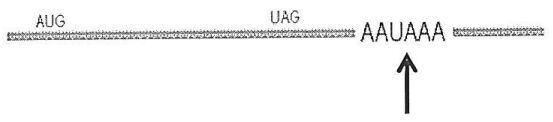
32. The most likely consequence of a mutation present at the location indicated by the arrow in the above hnRNA schematic would be: (圖表請見試卷) (A) none, this region of the RNA has no function (B) aberrant splicing of the RNA (C) the mRNA would be improperly capped (D) the mRNA would be unstable and prone to degradation (E) an altered response to regulatory factors
a) Will always have an equal percentage of A and G, and an equal percentage of C and T: (A) DNA (B) mRNA (C) tRNA (D) More than one of the above (E) None of the above
b) Has an anticodon and carries an amino acid:(A) DNA (B) mRNA (C) tRNA (D) More than one of the above (E) None of the above
c) Serves as a messenger for taking genetic information from the nucleus to the cytoplasm: (A) DNA (B) mRNA (C) tRNA (D) More than one of the above (E) None of the above
d) Involved in the process of translation:(A) DNA (B) mRNA (C) tRNA (D) More than one of the above (E) None of the above
e) Partially unzips/unwinds during the process of transcription: (A) DNA (B) mRNA (C) tRNA (D) More than one of the above (E) None of the above
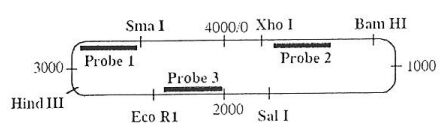
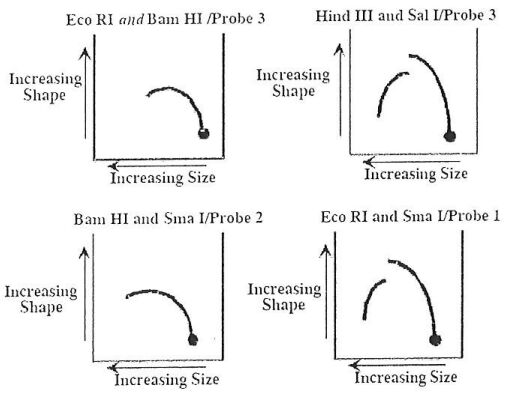
2. You are studying a novel thermophilic eukaryote called S. mokin. You found that some S. mokin cells contain a 4 kb plasmid with B form double strands DNA. You use 2D gel analysis to locate the origin of replication in the plasmid and obtain the following results. The replication origin is located between which 2 restriction enzymes (the shortest regions):
________ and ________
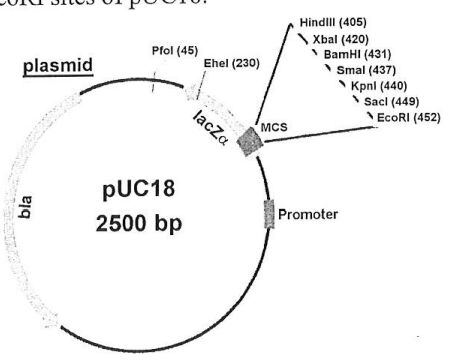
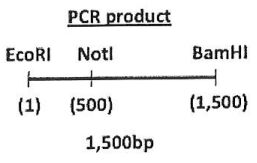
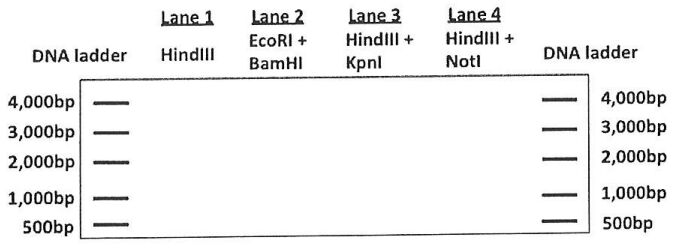
3. Below are shown schematics of a 1,500bp PCR product and the pUC18 plasmid, with important restriction sites and their position in parentheses. You clone the PCR product between BamHI and EcoRI sites of pUC18.
For each lane of the agarose gel below, show the bands that will result from digesting your plasmid (pUC18 with your PCR product inserted between BamHI and EcoRI sites) with the indicated restriction enzymes. On the left and right sides of the gel are DNA ladders to serve as comparison. As shown above, the insert PCR product is 1,500bp, and pUC18 plasmid is 2,500bp.
 阿摩線上測驗
登入
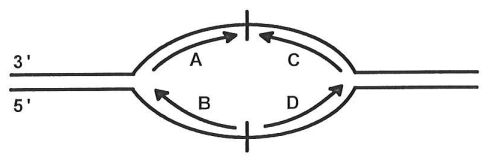 (A) A (B) B (C) C (D) D
 (A) defective transcription initiation (B) normal protein, this is a silent mutation (C) defective translation initiation (D) shorter protein, this is a nonsense mutation (E) Glycine → Serine mutation in the protein
 ]. (A)
 (B)
 (C) 1/6*109 (D)
 (E)

 (A) Site specific recombination between two linear chromosomes result in exchange of segment. (B) Site specific recombination between two circular chromosomes will result in insertion. (C) Site specific mutation in one linear molecule will lead to excision. (D) For recombination to take place recombinase is a must.