阿摩線上測驗
45.70歲女性為肺癌病人,因右腳無力就診,抽血檢查發現D-dimer檢驗數值為16 mg/L(正常值為<0.5 mg/L),腦部磁振造影(MRI)檢查結果如下圖(①fluid–attenuated inversion recovery [FLAIR];② 施打顯影劑之T1影像;③diffusion–weighted imaging [DWI])。下列何者最可能是腦部病灶的原因?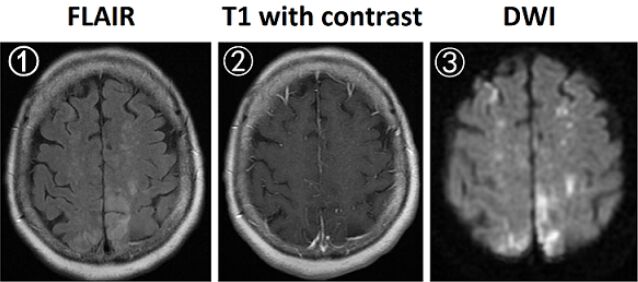
(A)多發性腦轉移
(B)肺結核感染
(C)可逆性後腦病變症候群(posterior reversible encephalopathy syndrome, PRES)
(D)多發性腦梗塞
答案:登入後查看
統計: A(100), B(4), C(132), D(493), E(0) #3261109
統計: A(100), B(4), C(132), D(493), E(0) #3261109
詳解 (共 2 筆)

到底在考三小
#6460095
手把手教你看MRI(考試的MRI不是臨床的):
先背基礎知識
- T1看油 T2看水
- Flair就是T2拿來看水的,只是把腦室的水拿掉(正常的水不拿掉不亮)
- DWI: diffusion weight imaging: 記得D是diffusion所以是看 限制水移動
- ADC: 是看水的移動能力(基本上就是DWI的相反,下面會講為啥相反還要量兩個)
ㅤㅤ
送卡:
| 病變例子 | DWI(高訊號) | ADC(低訊號) | 解釋 |
|---|---|---|---|
| 急性腦中風 | {{c1::高}}訊號 | {{c1::低}}訊號 | 細胞腫脹 → 水分子無法自由擴散 ({{c1::cytotoxic}} edema) |
| 膿瘍 | {{c1::高}}訊號 | {{c1::低}}訊號 | 膿液中大量細胞殘渣限制水擴散 |
| 慢性梗塞/囊腫區域 | {{c2::高}}訊號 | {{c2::高}}訊號 | 為 {{c2::T2 shine-through}},非真正擴散受限 ({{c2::vasogenic}} edema) |
| 慢性中風、壞死區 | {{c2::低}}訊號 | {{c2::高}}D訊號 | 結構鬆散,水分子可自由移動 |
ㅤㅤ
所以看前兩個跟最後一個會覺得DWI跟ADC完全相反根本不用驗兩個
問題是出在DWI是T2的image也就是水超多的時候一樣會亮起來,所以在慢性梗塞或囊腫區域會有T2 shine through的狀況:
T2 Shine through
-
在 DWI 中,高訊號可能來自 T2 加權效應(不是擴散限制)。
-
此時會看到 ADC 也是高訊號 → 表示無擴散限制。
ㅤㅤ
這邊其實還能扯到另一個考點: vasogenic edema跟cytotoxic edema避免扯太多講重點:
vasogenic edema用steroid才有用,cytotoxic不要用
ㅤㅤ
送卡:
出血性中風 控制:
1. 血壓控制SBP<{{c1::130-150}}
2. 腦壓控制: 大腦灌流壓CPP>{{c1::50-70}} mmHg, 避免用{{c1::steroid}} ({{c1::vasogenic edema}} 用{{c1::steroid}}才有用)
3. 評估手術時機: 小腦出血>{{c2::3cm}} or >{{c2::30 ml}}, 年輕大腦出血>{{c2::50cc}}且{{c2::中重度昏迷}}
1. 血壓控制SBP<{{c1::130-150}}
2. 腦壓控制: 大腦灌流壓CPP>{{c1::50-70}} mmHg, 避免用{{c1::steroid}} ({{c1::vasogenic edema}} 用{{c1::steroid}}才有用)
3. 評估手術時機: 小腦出血>{{c2::3cm}} or >{{c2::30 ml}}, 年輕大腦出血>{{c2::50cc}}且{{c2::中重度昏迷}}
20
0

HJ C
#6485189
Posterior reversible encephalopathy syndrome (PRES)
ㅤㅤ
- Definition: a neurologic condition characterized by vasogenic edema in the subcortical white matter, especially in the posterior cerebral hemispheres
- Etiology
- Increased blood pressure (severe hypertension, preeclampsia, eclampsia)
- Renal failure
- Sepsis
- Certain autoimmune diseases (e.g., systemic lupus erythematosus)
- Certain antineoplastic drugs and immunosuppressant drugs (e.g., cyclosporine, cisplatin, cyclophosphamide)
- Clinical features: severity of symptoms may vary
- Seizures (most common)
- Headache (constant, generalized, unresponsive to analgesics)
- Visual disturbances
- Nausea, vomiting
- Altered mental status
- Diagnostics
- Treatment
- Treatment of the underlying cause (e.g., blood pressure monitoring and antihypertensives, dose modification or discontinuation of immunosuppressive therapy)
- Seizure prophylaxis with anticonvulsants
- Prognosis
- Complete recovery over days to weeks occurs in approx. 80% of cases
1
0